Tuesday, June 7, 2016

Top Ten Reasons Why I Love Reading

Top Ten Tuesday is a weekly meme hosted over at The Broke and the Bookish.  This week's theme is quite open-ended, asking bloggers to post the top ten reasons why we love absolutely any subject, hobby, book series, or etc.  I have decided to do perhaps the most obvious thing for a book blog and blog about why I have been an avid--not to say obsessive, though one might say that!--reader since childhood.  Here are the top ten reasons why I love reading, accompanied by quotes about being bookish by bookish people:


1.
"Libraries are fascinating places: sometimes you feel you are under the canopy of a railway station, and when you read books about exotic places there's a feeling of traveling to distant lands."  --Umberto Eco, The Prague Cemetery
I love books that describe scenery and faraway countries so vividly that I can visualize them and begin to scheme about visiting the settings of my favorite books.  Of course, with fantasy and science fiction we can also visit places far more exotic than one can reach via a railway station or a plane.

2.
"A book must be the axe for the frozen sea within us." --Franz Kafka

3.
"Learning of all enterprises is alone immortal and divine." --Plutarch
No one can take your education away from you, and books are the best teachers in that we get to interpret them for ourselves.

4.
"O blessed Letters, that combine in one
All ages past, and make one live with all;
By you we doe conferre with who are gone,
And the dead-living unto councell call:
By you th' unborne shall have communion
Of what we feele, and what doth us befall." --Samuel Daniel
Pictured above is the grave of John Keats, one of my favorite English poets who died when very young.  Although I did get to see the Keats House while in Rome last summer, I sadly did not get to visit his grave.  The vibrant red flowers speak to what Samuel Daniel was talking about in his Renaissance-era poem: reading is an act of communion with people we have never met and, often, with the dead.  We feel as if we know our favorite authors and cherish them and their words.  Writers and readers alike are in a sense able to overcome the barriers of time and even death.

5.
"I lived in books more than I lived anywhere else." --Neil Gaiman, The Ocean at the End of the Lane
When one's day-to-day surroundings are oppressive (or perhaps simply mundane), books can provide us with a happy second home or a bit of escapism. 

6.
"A mind needs books as a sword needs a whetstone, if it is to keep its edge." --George R.R. Martin, A Game of Thrones
Reading keeps you sharp!

7.
"Books continue each other, in spite of our habit of judging them separately." -- Virginia Woolf
When one reads and likes one book, that can open up hundreds of other avenues, like newly-discovered aisles in the library.  We might decide we absolutely have to read everything else by a certain author, discover a new genre, or want to read a book that an author or character references to better understand what they are talking about.  All writers are obviously strongly influenced by earlier writers, and it helps to understand where their ideas, style, and inspirations originated.

8.
"We live for books.  A sweet mission in this world dominated by disorder and decadence." --Umberto Eco (again!), The Name of the Rose
Apparently, this is a photograph of Umberto Eco's personal library.  As a graduate student in the humanities, I feel incredibly fortunate to be able to call reading and writing my vocation, like the monks in The Name of the Rose. 

9.
"Books are not about passing time.  They're about other lives.  Other worlds.  Far from wanting time to pass, one just wishes one had more of it.  If one wanted to pass time, one could go to New Zealand." --Alan Bennett, The Uncommon Reader 
I have not read The Uncommon Reader yet, but saw this great quote on Goodreads.  No reader ever has enough time to read all the books in their tbr pile, because it only ever grows taller! 

10.
"If you have enough book space, I don't want to talk to you." --Sir Terry Pratchett


I love the aesthetic side of reading as well, and don't know what I would do without my overflowing bookshelves and my beautiful Penguin Classic editions!

All of these quotes are from my commonplace book, to which I'm always adding new quotes about the joys of bookishness, among other things.  Anyway, I hope you enjoyed this post, and would love to know why you love reading!  Leave the link to your top ten list when you comment and I will be sure to return the visit!

Saturday, June 4, 2016

Saint Joan by George Bernard Shaw

Genre: play
Pages: 160
Published: 1923


I really enjoyed this play, the first I have ever read by George Bernard Shaw.  Set in fifteenth century France during the Hundred Years War, it is Bernard Shaw's interpretation of the story of Joan of Arc, revered as both a French heroine and a saint (but only since 1920, nearly 500 years after she was burnt at the stake as a heretic!)  I will make a very strange comparison and say that the play reminded me a bit of a particularly brilliant episode of Game of Thrones.  It is a series of fascinating, sometimes philosophical and sometimes funny and always confrontational conversations.  Bernard Shaw foregoes writing any bloody battle scenes and instead concentrates on developing Joan's character and those of the people who condemned her as a heretic, as well as her supposed allies who essentially stood by and let her be condemned.

I liked that Bernard Shaw portrays Joan as a human being, complete with a very stubborn nature and a propensity for lightly making fun of her supposed social betters to their faces.  Honestly, desperate though he might have been, would the dauphin have listened to just any country girl who told him that he could only win back French territory and be crowned if he let her lead his army against the English?  No, divinely inspired or not, Joan of Arc must surely have been one tenacious, determined, and even slightly arrogant young woman.  She was certainly bold, even reckless enough to suddenly and a bit mysteriously recant her confession at her trial when she had might have been imprisoned for life rather than burned at the stake.  Bernard Shaw portrays her as all of these things, as very human.
First printing of Saint Joan

Joan was burnt not as a witch, as is sometimes thought, but as a heretic.  She was tried by a Church tribunal not only for political reasons, but because the Church officials perceived that she felt her direct divine connection to God meant that she must obey Church authority only if it did not go against what her "voices" told her was God's will.  Cauchon, the preceding bishop, is actually sympathetic to Joan in the play, not the kind of heartless Catholic monster that a less thoughtful Protestant playwright might have written him as.  He tries hard to convince Joan to submit to "the considered wisdom and experience of the Church," but she refuses to believe her spirits could be wrong.  So, Joan was maybe a bit of a Protestant.  Bernard Shaw actually uses the word "Protestantism" several times in the play, though it is an anachronism, to drive home this point.  Though his subject is medieval, the play is very much a product of the 1920s, especially as it reflects on Joan's recent canonization as a saint in 1920.

In the epilogue, a surreal scene in which Joan and those who condemned her reflect on her legacy as ghosts, King Charles VII (formerly the dauphin) says:

"...But I will tell you this about her.  If you could bring her back to life, they would burn her again within six months for all their present adoration of her."

In short, Bernard Shaw means that Joan is revered as a martyred saint, but was ridiculed and mistreated during her life.  People, whether religious or not, are happy to think of her as a misunderstood "woman ahead of her time," a martyr and a national heroine.  But people like Joan--a cross-dressing, sharp-tongued woman who rode into battle and claimed she regularly spoke to Saint Catherine and knew what was best for everyone better than they themselves did--are often better-loved after they are dead, and treated as outcasts or lunatics while they are alive.  This was a fascinating perspective on Joan that I had never considered before.

This play is also very funny at times.  Bernard Shaw's dialogue reminded me of that of Oscar Wilde, to whom he is sometimes compared, in that he is good at writing aphorisms and witty remarks.  Here are a couple of the quotes that I particularly appreciated:

Charles: "If we could only have a treaty, the English are sure to have the worst of it, because they are better at fighting than at thinking."

"Poulengey:  "...We want a few mad people now.  See where the sane ones have landed us!"

This play is:

poignant, engrossing, surprisingly funny


P.S. I have decided to phase out my old rating system, which basically uses the Goodreads system and substitutes unicorns for stars.  One of the benefits of writing reviews is that I can assess books in a more qualitative fashion, and I often cannot even explain to myself why I gave a book four stars instead of five or vice versa.  It seems to depend largely on my mood at the moment, so I am going to try using adjectives to sum up my feelings towards and perceptions of books instead.

...This review is part of my Classics Club project!

Thursday, June 2, 2016

Locke & Key by Joe Hill, Gabriel Rodríguez (Series Review)

Genre: graphic novel, fantasy/horror
Pages: 6 volumes, about 180 pages each
Published: 2014

Synopsis: Locke & Key tells of Keyhouse, an unlikely New England mansion, with fantastic doors that transform all who dare to walk through them. Home to a hate-filled and relentless creature that will not rest until it forces open the most terrible door of them all...

Review:

I originally intended to review this series volume-by-volume, but I think a series review will be better.  Locke & Key has a plot with so many twists and different characters introduced in each volume that I don't think I would have much to say about each individual volume without revealing tons of spoilers.

I started reading the Locke & Key series because I love, love, love anything to do with haunted mansions on mysterious islands.  The title of the first volume, Welcome to Lovecraft, also caught my eye because I recently read a ton of HP Lovecraft stories and really enjoyed them.  Because the individual volumes are unreasonably exorbitant at $25 each, I made a gamble and bought the box set with all six volumes to save about $100.  I love gorgeous box sets!

Locke & Key is the story of siblings Tyler, Kinsey, and Bode, who move with their mother to a family property on the East Coast after their father, a school guidance counselor, is tragically murdered by a deranged student.  Keyhouse is enormous and filled with mysteries, as six-year-old Bode finds out when he discovers that there is a serious echo in the estate's well-house.  Not merely an echo that repeats what Bode says, but an echo that speaks back to him and seems to know a lot about his father and his troubled family...
The "echo" in the well begins to emerge.

The echo bides Bode to find a key in the house which will set it free.  Meanwhile, Sam Lesser, the boy who killed the Locke kids' father also hears the voice of the thing that lives in the well while in prison on the other side of the country.  Sam manages to escape from jail and sets off to finish murdering the rest of the Locke family at the "echo's" behest.

The keys hidden around Keyhouse prove to be the Lockes' only defense against the incredible numbers of deranged killers and shadowy monsters that seek to destroy them and open a gateway to another, more brutal world in the town of Lovecraft.  These are extraordinary keys forged by Keyhouse's former inhabitants from an otherworldly substance and which can do virtually anything they are designed to do.  One key can unlock someone's head, permitting all of their memories to be removed or new ones planted.  Another can transform a person into an animal, another can give them wings.
Kinsey Locke trying out her wings

I cannot really write much more about the various supernatural threats which the Lockes encounter without spoiling at least the first volume.  However, I can say that it is not simply the fantasy elements or the simply gorgeous full-color illustrations that caused me to read all six volumes within about a week.  (To clarify, for many years the only graphic novel type books that I read were manga, which are largely inked in black and white, so I still find myself somewhat impressed upon reading full-color graphic novels.  My reaction would probably be comical to devoted readers of Western-style comics, but I catch myself thinking, "Wow, they colored in everything?!")

My favorite aspect of Locke & Key is the characters, especially the major characters Tyler and Kinsey.  These teenagers confront bizarre, catastrophic, and possible apocalyptic circumstances like...well, like most teenagers would!  Tyler feels an extraordinary amount of guilt about his father's death and tries to adjust to his new school by joining the hockey team, though he doesn't like hockey, and spending most of his time with Zach Wells, a smooth-talking guy whose history he knows very little about.  Kinsey is also dealing with her fair share of guilt and grief.  She is quick to use the magical keys to attempt to solve her problems, literally removing all her fears and insecurities from her head with the "head key" and giving herself wings to fly far away from Keyhouse and the school where she has trouble deciding where (or if) she fits in.  The fact that Kinsey has a different hair style in almost every volume is, to me, so reflective of the transitional and confusing place that she finds herself.  Some of my other favorite characters are Kinsey's friends Scot, Jackie, and Jamal.  They are very visibly the outsiders at preppy Lovecraft Academy, and provide a lot of the series's humor.  Did I mention Locke & Key is hilarious?  Because it is.

Ironically Joe Hill, the brilliant writer behind Locke & Key, is the son of that other renowned horror writer whose book Bag of Bones I just wrote a very meh review of, Stephen King.  While his horror novels seem to be as enormous as his father's, I do hope to try reading one of Joe Hill's books, perhaps NOS4A2.  Apparently it is both a vampire book and Christmas-themed???  OK, because we are talking about the author of Locke & Key, I will give it a shot!

Series Rating:


Update to 2016 Graphic Novel/Manga Reading Challenge: with Locke & Key, I have now read 6 of the 24 graphic novels I hope to have read by the end of this year!


Wednesday, June 1, 2016

Northanger Abbey by Jane Austen

Genre: classic
Published: 1817
Pages: 250

In her first novel Northanger Abbey, Jane Austen defends fiction in a manner that any ardent reader can not but highly approve of and applaud:

“It is only a novel... or, in short, only some work in which the greatest powers of the mind are displayed, in which the most thorough knowledge of human nature, the happiest delineation of its varieties, the liveliest effusions of wit and humor, are conveyed to the world in the best-chosen language.”

Northanger Abbey is definitely such a novel, though it seems to be sadly underrated compared to other Austen novels.  What it may lack a little in page count and dynamic secondary characters, in displaying "the most thorough knowledge of human nature," it more than makes up for in "the liveliest effusions of wit and humor."  Here Austen employed her usual candid wit to satirize not only certain elements and stock figures of English high society, but also the lurid Gothic romances like The Monk that were the bestsellers of her day.  The result is marvelously entertaining to read and often very funny.

Seventeen year old Catherine Morland is considerate and vivacious, a devoted reader of Gothic romances and a life-long country dweller.  When she has the opportunity to travel to Bath with family friends and spend a few months taking tea in gathering rooms and dancing with eligible young men, Catherine jumps at the chance, though she knows little of the manners of high society.  However, as Austen's omniscient narrator explains, Catherine's unworldliness can only work to her advantage in the game of attracting a suitor:

"She was heartily ashamed of her ignorance.  A misplaced shame.  Where people wish to attach, they should always be ignorant.  To come with a well-informed mind, is to come with an inability of administering to the vanity of others, which a sensible person would always wish to avoid.  A woman especially, if she have the misfortune of knowing any thing, should conceal it as well she can."

One can easily imagine Jane's sardonic smile as she put that last line to parchment.
Sketch of a pump room or gathering room in Bath

Catherine initially feels as if she knows no one in Bath, but luckily makes the acquaintance of a certain Mr. Henry Tilney, a clever and charming young man whom she quickly falls in love with.  Like any heroine, however, Catherine is beset by countless obstacles.  Isabella, another of her new friends in Bath must insist on carrying on in an embarrassing way with Henry's less pleasant elder brother, though she is engaged to marry Catherine's brother!  Likewise, Isabella's odious brother John has made up his mind that he is going to marry Catherine, despite the latter's indifference to his pathological lying and scheming.  Happily, Catherine is able to escape this intricate and embarrassing situation in Bath after Mr. Tilney and his sister invite her to sojourn at their family home, Northanger Abbey.  Catherine is delighted with the abbey and with her hosts...except for General Tilney, Henry's father.  As she learns more and more about the sudden death of the late Mrs. Tilney at Northanger Abbey, Catherine begins to suspect that the highly suspicious General poisoned his wife, or else is hiding her away in some secret passage...

Some readers have complained that the love interest Mr. Tilney is no Mr. Darcy or that he is a bit of a 2-D character, but I actually found him to be pretty nearly as well-written as Catherine and just...likable.  Fancy that, a love interest being kind and likable instead of going to incredible pains to convince the heroine that he hates her in order to disguise his great passion, or being some "bad boy" that the heroine has to work to redeem!  It makes for a nice change.  I particularly like his first conversation with Catherine, in which he ironically recollects after talking with her a while that he has forgotten to ask her all the stereotypical small-talk questions about how she likes Bath:

"...forming his features into a set smile, and affectedly softening his voice, he added, with a simpering air, "Have you been long in Bath, madam?"
Catherine and Henry Tilney in the 2007 Northanger Abbey film

"About a week, sir," replied Catherine, trying not to laugh.

"Really!" with affected astonishment.

"Why should you be surprised, sir?"

"Why, indeed?" said he, in his natural tone--"but some emotion must appear to be raised by your reply, and surprise is more easily assumed, and not less reasonable than any other."  

I also enjoyed the conversations in which Henry playfully parodies Catherine's expectations that Northanger Abbey will be a haunted Gothic monastery filled with relics of the horrible murders which have taken place there, inventing a whole story about her frightening discovery of a secret passageway.  However, I guess I cannot quote every passage that I loved here!

Just as Catherine Morland must eventually confess to having been influenced by her insatiable love for reading Gothic romances to judge people before getting to know them, I must confess to having been influenced by my love for Northanger Abbey!  After reading it for the first time a few years ago, I determined that I absolutely must read some of these "horrid novels" that Catherine and her friend Isabella thrill over in the book.
Delightful Penguin cover for The Monk
I haven't managed to get through the infamous The Mysteries of Udolpho, whose beginning didn't inspire a lot of interest.  However, I have read Matthew Lewis's The Monk, Horace Walpole's The Castle of Otranto, Lady Audley's Secret by Mary Elizabeth Braddon, and a number of Gothics by Wilkie Collins, primarily to see if they were as silly as Austen suggests in Northanger Abbey.

My verdict is that yes, Gothic romances can be ridiculous and long-winded, but they are also thrilling and suspenseful and delightfully convoluted, a bit like soap operas.  I have no trouble understanding why Catherine and Henry might burn the midnight oils to finish these tales of wronged ghosts seeking revenge, wide-eyed heroines, wicked foreign counts, and unpleasant housekeepers, all set in the most imposing and medieval of architectural structures.  Austen's book is a satire of the Gothic thriller, certainly, but as an unabashed fan of the much-maligned genre, I also appreciate her homage to it by way of clever parody.  I hope to read more Gothic romances of the sort that Catherine might have encountered soon.  As a graduate student studying that period, I can half-convincingly claim them as necessary reading, and I really want to give Ann Radcliffe another chance!

Rating:
5/5 stars

This book is one I selected for my Classics Club challenge list.  Fortunately, I am off to a pretty good start and have not neglected reviewing the books I read thus far.  I am still working on my review for The Awakening--it is turning out to be a difficult book to review!


Monday, May 30, 2016

Top Ten Tuesday: Beach Reads

Top Ten Tuesday is a weekly bookish meme hosted by the bloggers at The Broke and the Bookish.  This week, we are listing our top ten favorite beach reads.  While I love the beach and my home state is home to some of the most beautiful beaches in the US, I only very rarely get to travel to the coast, much less relax and read there.  I also do not read many breezy, beach-friendly books.  So, my top ten list includes my favorite books which are set at the beach, on an island, or at sea!

1.
Along for the Ride by Sarah Dessen
While I don't usually read a lot of contemporary young adult novels, I absolutely adore Sarah Dessen.  She is a native of my native state, North Carolina, after all, and I love to read her compelling books set in small towns along the beautiful NC coast.  Along for the Ride is one of my favorite Dessen books.

2.
And Then There Were None by Agatha Christie
I recently read and reviewed And Then There Were None, and was truly captivated by it!  This Agatha Christie novel is a suspense story in which ten people are invited to a small, picturesque island as the party guests of an unknown host.  One by one, the guests are mysteriously murdered.  It becomes clear that someone thinks they all deserve to die, but why and will the murderer succeed in dispatching all of the stranded guests?

3.
The Awakening by Kate Chopin
I am writing my review for The Awakening right now, and hope to have it posted soon.  This novella, set in French Louisiana, is the story of Edna Pontelier, a married woman who embarks on an affair and a process of self-discovery.  Chopin definitely invokes the sea, as in this beautiful quote: “The voice of the sea is seductive; never ceasing, whispering, clamoring, murmuring, inviting the soul to wander for a spell in abysses of solitude; to lose itself in mazes of inward contemplation. The voice of the sea speaks to the soul."

4.
Beauty Queens by Libba Bray
I reviewed this book a few years back and gave it 4 of 5 stars.  The story involves 50 American Junior Miss beauty pageant competitors who end up stranded on a desert island after their plane crashes and must cooperate in order to survive.  It's a bit on the longer side as far as YA novels go, but lots of fun and not without its more insightful character moments.

5.
Moloka'i by Alan Brennert
I often have a difficult time convincing people to read this book.  It's about a young girl in Hawaii who, along with some of her family and many of her community members, discovers she has Hansen's Disease (leprosy) and has to live for many years on the isolated island of  Moloka'i with the rest of her fellow sufferers.  Yeah, can't imagine why people often seem reluctant to read this book!  It is by no means uplifting, but the characters and their incredible courage, heart, and love for one another make Moloka'i an amazing read.  I really give Alan Brennert credit for writing so beautifully about a place and people which even historians are often ignorant about.  If people think of Moloka'i at all, they probably think of Saint Damian de Veuster, the European priest who worked and ministered on the island until he himself also contracted Hansen's Disease.  In this book, the largely forgotten Hawaiian people who lived and essentially waited to die on Moloka'i are the focus.

6.
The Ocean at the End of the Lane by Neil Gaiman
Everything Neil Gaiman writes is gold, in my humble opinion.  This book is a short one, perfect if you haven't the time to tackle American Gods or the complete Sandman.

7.
Rebecca by Daphne du Maurier
"Last night I dreamt I went to Manderley again."  This is one of my favorite novels, though du Maurier's My Cousin Rachel may be even better.  The newly-married Mrs. de Winter, a shy young woman whose first name we never learn, arrives at Manderley, the beautiful estate by the sea owned by her husband Max.  She finds that Manderley is haunted by an exceedingly unpleasant housekeeper and the overpowering memory of the first Mrs. de Winter, a certain Rebecca.  I could not recommend this one enough!

8.
The Sea of Trolls by Nancy Farmer
I would locate this historical fantasy book and its two sequels somewhere along the blurry borderlands of young adult and middle grades.  Young Jack is kidnapped from his home by brutal and half-mad Vikings, including the valiant but equally brutal shieldmaiden Thorgil.  In Jack's world, all the creatures from Norse mythology--including everyone's favorite, trolls!--are all too real.  It is nice to see a series that focuses on Norse beliefs and cosmology, since most fantasies seem to overwhelmingly borrow from Greek myth.

9.
The Tempest by William Shakespeare
The Tempest was probably Shakespeare's last play and includes his farewell to his audience and to playwriting through words spoken by the magician Prospero, who has spent many years stranded on an island.  The cross-dressing comedy Twelfth Night also begins with a shipwreck, and I cannot forego mentioning it because it's one of my favorites!
    
10.
Yet another mysterious island, this one supposedly the location of a marvelous buried treasure!  Before I read it, I thought I already knew the story of Jim and Long John Silver like the back of my hand from having seen so many series and movie adaptations.  I was wrong, of course.  As usual, reading the original book even if you think you know the story proved to be more than well-worth the effort, for there are psychological depths in this book that are not present in many of the adaptations.

I hope you picked up a few ideas for your TBR from my list, and would love to read yours.  Feel free to leave a link to your Top Ten when you comment!

Friday, May 27, 2016

Bag of Bones by Stephen King


Genre: horror
Published: 1998
Pages: 736

Synopsis: Four years after the sudden death of his wife, forty-year-old bestselling novelist Mike Noonan is still grieving. Unable to write, and plagued by vivid nightmares set at the western Maine summerhouse he calls Sara Laughs, Mike reluctantly returns to the lakeside getaway. There, he finds his beloved Yankee town held in the grip of a powerful millionaire, Max Devore, whose vindictive purpose is to take his three-year-old granddaughter, Kyra, away from her widowed young mother, Mattie. As Mike is drawn into Mattie and Kyra's struggle, as he falls in love with both of them, he is also drawn into the mystery of Sara Laughs, now the site of ghostly visitations and escalating terrors. What are the forces that have been unleashed here—and what do they want of Mike Noonan?


Review:

As an assistant at my high school's library, I came to know the titles and covers of Stephen King's books very well.  They were some of the few books at the school library that I had to constantly check in and out; Stephen King is very popular with teenagers, as well as with everybody else.  I myself checked out Carrie, which I didn't really like, and Firestarter, which I loved.  Other than that, I had not read any of Stephen King's oeuvre until I picked up Bag of Bones a few weeks ago, although I love horror and the film adaptations of King's novels like Misery and the Shining.

Unfortunately, Bag of Bones did not live up to the high expectations I had for Stephen King.  This book is an absolute brick, weighing in at more than 700 pages, and though it starts off with a bang (the death of Mike Noonan's wife Jo), I found the story to be surprisingly slow-paced after that.  King actually does an excellent job creating Joanna as a likable character, even though she dies in the first few pages.  He also sets up this mystery of what she might have been up to before she died (Noonan discovers she was secretly pregnant with a child that might not have been theirs together.)  But the reader has to slog through about a hundred pages of Noonan grieving for Jo and having the occasional creepy dream about their lake house before he actually decides to go to the lake house, called Sara Laughs, on Dark Score Lake.  

An old lakeside shack with a pretty but eerie name and a dark past!  I had a feeling the book was going to become a lot more interesting, and it did.  A little.  King's writing and the level of detail which he delves into is such that he makes the atmosphere and the characters feel incredibly real.  It is also such that I felt myself growing a bit bored on more than a few occasions.  I wanted to learn more about that old creep Max Devore, determined to steal the daughter of Mike's new friend Mattie, not read about Mike going to the Village Café for the third time.  The haunted happenings in the lake house Sara Laughs progress a bit stereotypically, for someone who freely admits to having watched every episode of Paranormal Witness.  Mike feels a cold breeze, the magnets rearrange themselves on his fridge, he hears a child crying, he dreams about corpses (a lot!)  The aspect of the novel I liked best was Mike's discovery of the tragic story of Sara Tidwell, the original "Sara Laughs," a Blues singer who lived and died near Dark Score Lake.  

And the aspect of the novel I liked least, other than the overly detailed writing and slow pace?  That would be the protagonist and first-person narrator, Mike Noonan.  It is easy to feel sorry for him since he has lost his wife, but for whatever reason, I did not find it so easy to like him.  Admittedly horror is not a genre known for its likable characters.  Protagonists in horror tend to have shadowy pasts and dark secrets, which is interesting, but Mike did not even have that.  His deceased wife Jo was the one with the unknown past and secrets, but the story is narrated by Mike, not Jo.  And Mike is a bit bland, as are a lot of the characters he meets around Dark Score Lake.  

Not so Pierce Brosnan or Anika Noni Rose, though!  After I finished reading Bag of Bones, I watched the 2011 mini-series.  It stars Pierce Brosnan as Mike Noonan and features Anika Noni Rose (The Princess and the Frog, Dreamgirls) as the Blues singer Sara Tidwell.  While I would by no means call Bag of Bones the greatest horror mini-series ever, it was well-acted, riddled with creepy jump scares, and tells basically the same story as the seven hundred page novel in a mere two hours.  Best of all, the mini-series can currently be watched for free on Youtube.

In short, this is one of very few cases in which I would recommend the movie instead of the book.  I really wanted to like Stephen King.  He is obviously a masterful writer, but honestly, the slow pacing of his books and their high page counts may mean that they are not for me.  However, if anyone knows perhaps a lesser-known Stephen King book that they really enjoyed, then I would love a recommendation.

My rating:

Tuesday, May 24, 2016

Astrophil and Stella by Sir Philip Sidney

Genre: poetry (sonnets)
Published: 1591
Pages: about 80

Review:

Poor, lovelorn Philip Sidney!  He anguished so much about his romantic misfortunes that he absolutely had to pen a sonnet cycle about his beloved, or, more accurately, about the complex and mutable emotions that he felt towards his beloved, Stella.  He often decries his own lack of poetic wit with a kind of transparent modesty, and just as often declares, sometimes quite vehemently, his absolute aversion to borrowing from other poets' work:

"And this I swear by blackest brook of hell,
I am no pick-purse of another's wit" (Sonnet 74)

The source of his inspiration?  His beloved, of course:

"My lips are sweet, inspired with Stella's kiss."

Be that as it may, with his 108 sonnets and 11 longer songs, Sidney was following in the sonnet-writing tradition of Petrarch, who wrote dozens of Italian sonnets addressed to his beloved "Laura."  It has been quite a while since I read those for a class, but I don't recall that Petrarch ever did more than regard Laura from afar (in other words, subtly stalk her).  After Laura died young, Petrarch continued to write sonnets about her, complete with imagery of Laura as a heavenly angel, even more worthy of his worship and praise than she had been while alive.
Sir Philip Sidney

Now, that's romantic!...or maybe that's just creepy?  Personally, I feel it's more than a bit creepy, but one cannot deny that both Petrarch and Philip Sidney wrote some beautiful sonnets about their respected beloveds which went on to have a huge influence on literary conventions and the way people write/think about love, desire, beauty, and especially unrequited love.

Reading some of Sidney's sonnets, I could not help but draw a parallel between

"Her eyes, her eyes
Make the stars look like they're not shining" (Bruno Mars, 2010)

and

"When Nature made her chief's work, Stella's eyes,
To color black why wrapped she beams so bright?" (Sonnet 7)

Sidney continues later in that sonnet, still writing of Stella's dark eyes,

"That whereas black seems beauty's contrary,
She even in black doth make all beauties flow"

making me think immediately of Shakespeare's very famous "dark lady" sonnets.  Since Sidney's sonnets predated Shakespeare's, might he have been inspired by Sidney just as Sidney was by Petrarch?

I have also read Shakespeare's sonnets, and enjoyed them perhaps more than Astrophil and Stella.  Shakespeare (or, at least, Shakespeare's speaker) constructs elaborate puns and playful metaphors, and attempts to bring most of the sonnets to a quasi-resolution in the final quatrain.  Sidney, on the other hand, tends to come across as more solemn, melancholy, and tormented, as in sonnet 2:

"Not at first sight, nor with a dribbèd shot
Love gave the wound, which while I breathe will bleed,
But known worth did in mine of time proceed,
Till by degrees it had full conquest got.
I saw and liked, I liked by lovèd not,
I loved, but straight did not what Love decreed;
At length t Love's decrees, I forced, agreed,
Yet with repining at so partial lot.
Now even that footstep of lost liberty
Is gone, and now like slave-born Muscovite,
I call it praise to suffer tyranny;
And now employ the remnant of my wit,
To make myself believe that all is well,
While with a feeling skill I paint my hell."

He writes of how he can scarcely eat, think, converse with women (who he says can only appear as poor "models" of Stella), cannot produce any writing which does not fixate on Stella, feels driven to paint his living hell with his words.  He suffers from an eternal wound made by Cupid's arrow (before that was such a huge cliché as it is today!)  He pines for the sight of Stella constantly and feels miserable in her absence:

"Since Stella's eyes, wont to give me my day,
Leaving my hemisphere, leave me in night" (sonnet 89)

 The hopeless melancholic in me just eats that stuff up!  Sidney might not have been as original with his extended metaphors or as clever with his sexual puns as Shakespeare, but he is perhaps more heartfelt.  While scholars can never seem to agree on who the "dark lady" and "beloved youth" of Shakespeare's sonnets might have been (or if they were real people at all), Sidney made it pretty transparent that "Stella" was in fact one Penelope Devereux, later called Lady Penelope Rich after her marriage.  He puns on her married name, "rich," quite a few times and, unlike Petrarch, Sidney actually had something of a history with Penelope.
Penelope Devereux, "Stella"

When Penelope was a young teenager and Sidney about twenty, their families had began negotiations for the two of them to be betrothed.  However, probably as a result of financial circumstances, the betrothal never happened and Penelope instead was forced to marry another nobleman whom she hated.  Indeed, she hated him so much that she had an affair with yet another nobleman, an earl, secretly married him, divorced her husband, married the earl "officially," and was banished from court shortly before she died.  (Sidney died many years earlier, a "heroic" death in battle which solidified his reputation as the ultimate Renaissance courtier/poet/soldier.)  Characteristically, Sidney sulkily blames himself for the marriage negotiations having fallen apart in his thirty-third sonnet:


"I might (unhappy word), O me, I might,
And then would not, or could not, see my bliss:
Till now, wrapped in a most infernal night,
I find how heav'nly day, wretch, I did miss.
Heart, rent thyself, thou dost thyself but right:
No lovely Paris made thy Helen his;
No force; no fraud robbed thee of thy delight;
Nor Fortune of thy fortune author is;
But to myself myself did give the blow..."

He laments,

"How fair a day was near.  O punished eyes,
That I had been more foolish, or more wise!"

How much of this was written in earnest and how much of it was Sidney self-consciously trying to introduce Petrarchan sonnets in England, no one can say.  But the result was quite extraordinary, that much is certain.  I enjoyed reading these sonnets and now intend to read Sidney's Defense of Poesy, which is an essay he wrote defending the merits of fiction against the criticisms of Puritans who called imaginative writing immoral.  I also would like to read more sonnets by a later English poet, perhaps Sir Thomas Wyatt, though I have heard his are not as good as Sidney's or Shakespeare's.

Rating:


This book is the first I have read and reviewed for my Classics Club challenge!  Next, I will review The Awakening by Kate Chopin.

Monday, May 23, 2016

Top Ten Tuesday: Books from My Childhood... and How I Feel Differently About Them After Time Has Passed

Top Ten Tuesday is a weekly bookish meme hosted by the bloggers over at The Broke and the Bookish.  This week's theme prompts us to list and discuss the "top ten books that I feel differently about after time has passed."  I had originally thought of posting about all the books that I hated after they were imposed upon me as required reading in high school but later liked after reading them and appreciating them on my own.  Then, while browsing the Goodreads equivalent of the dusty underside of my bed--the books I read back in 2010 or earlier--I happened across some of the books I read (and enjoyed) in elementary and middle school.  So today I'm going to take a nostalgic look back at some of the books which enriched--or didn't enrich--my childhood.

1.
the Baby-sitters Club series by Ann M. Martin
The library of my elementary school was pretty well-stocked with these books.  If you've ever read this once very popular kids' series, then you know that it centers on an ever-expanding cast of pre-teen girls who run their own small business babysitting neighborhood kids.  And then there are sub-plots with typical pre-teen problems.  For some reason, every one of these books basically opens with a twenty-page summary of the characters, their families, their interests, their medical histories, etc.  I know some kids were probably reading these books as stand-alones, but for an old Babysitters Club veteran like me, I remember trying to skip ahead past the character summaries to the action.  Such as it was.  I was never really into kids or babies or babysitting, and preferred books and little dinosaur toys to baby dolls, but for some reason these books held an attraction for me, along with probably millions of other young girls and some boys.  To give credit where credit is due, the characters are likable and diverse enough that most kids can find one to relate to.  My favorite was Claudia.  As a kid, I decided to emulate her habit of hiding candy and snacks around the room so her parents wouldn't catch her eating junk.  This led to a mouse briefly moving into my bedroom...oops, they didn't mention that in BSC #19, Claudia and the Bad Joke.

2.
Coraline by Neil Gaiman
Coraline was put on display in my middle school's library, and I remember regarding it warily for a few weeks before finally checking it out.  The cover is pretty darn eerie and, accordingly, so is the story.  I remember that I wasn't quite sure whether I liked this book or not.  It scared me a little.  In retrospect, I can appreciate Coraline for the gem of uncanny children's literature, in the tradition of Oz and Alice, that it is.  Coraline is the book that eventually kick-started my absolute adoration of Neil Gaiman and all his work, though I don't think I actually picked up American Gods, the novel that really won me over as a Gaiman fan for life, until high school.  I definitely recommend this book even for adults, because like a fairy tale it is the sort of story that can be read and enjoyed at any age, the tale of a bored young girl who wanders into an adjoining flat which resembles her own flat, but is magical and apparently "better." 

3.
the Inheritance Cycle by Christopher Paolini
Given their robust size (and I mean, robust, the entire series consists of nearly 3,000 pages), I probably spent a good chunk of my pre-teen and teenage years reading and rereading this dragon-themed fantasy epic.  Paolini was only sixteen when he published the first book, Eragon, and it does show a little, but his writing improved with each of the next three books.  Having now read The Lord of the Rings, it doesn't escape me that these books, um, borrow more than a little of their mythology, world-building, and plot from Tolkien.  Even the name Eragon...well, it sounds and looks almost exactly like Aragorn.  Not so subtle there, Paolini.  On the other hand, dragons!  Who doesn't love dragons?  We need more books about dragons, please, and no, I don't mean books about people who turn into dragons... I have hardcover editions of all the books in this series, and they are some of the most gorgeous books in my library. 

4.
the Goosebumps series by R.L. Stine
Did anyone else have nightmares as a child about being repeatedly slapped by a nightmarish little dummy with the charming and very fitting appellation of Slappy?  I chose the Night of the Living Dummy cover because the monster in that book bothered me the most as a child, but I actually read (and re-read and re-read) every book in the original Goosebumps series while in elementary school.  Iconic and nostalgic though they may be, R.L. Stine got away with a lot, in my retrospective opinion.  Slappy from the Night of the Living Dummy= Chucky from Child's Play, watered down for kids.  Deep Trouble...sounds like a junior version of Jaws.  The Barking Ghost, that was basically Pet Sematory.  Phantom of the Auditorium...do I really need to go on?  However, since (most) kids don't have access to these classic horror films, the material seems fresh and exciting to young readers.  I loved, loved, loved these books, even if they did give me the occasional nightmare!  Overall, I appreciate that these books first got me hooked on the horror genre, which I just enjoy more and more as time passes.  But in retrospect, how did R.L. Stine avoid being sued for some of these very familiar stories?  

5.
the Harry Potter series by J.K. Rowling
I don't have much to write about this series that hasn't already been written by myself and thousands of others.  The Harry Potter series were the books that initiated my life-long love of reading and learning at the age of six.  If I feel differently about them today, it is only because I appreciate them for their magic and powerful themes of friendship, humanity, and fighting against oppression even more than I did as a child. 

6.
the His Dark Materials trilogy by Philip Pullman
Readers may be more familiar with the first book, The Golden Compass or the Northern Lights, than the trilogy as a whole.  As children's books go, these books are the utter opposites of series like Goosebumps and the Babysitter's Club.  The universes (yes, plural) constructed in this series are complex and strange enough to rival that of Harry Potter.  The dangers that the protagonists Lyra and Will face and the often difficult decisions they make mean that the books hold an appeal for younger and older readers.  Older readers can read into the more philosophical tone and elements of the novels, while younger readers can enjoy the fascinating and unique adventure story.  I still consider these to be really formative books for me as a reader and as an individual.    

7.
Inkheart by Cornelia Funke
I probably checked out Inkheart from my middle school's library a dozen times.  It's a hefty adventure tale about a man who has the magical ability to "read" characters and things out of books, and the not so pleasant consequences of this ability which any reader would love to have.  When the 2008 film with Brendan Fraser was released, I was so excited, and then so disappointed!  The characters were, with the sole exception of Paul Bettany's Dustfinger, incredibly flat. Only a few years ago did I pick up the book again and realize that the source material may have been partially to blame.  The concept is fantastic, the homage to classic books enjoyable, but the plot and the characters do leave much to be desired.  I think the thing I loved most about this book as a kid was that it was about books, and people who love them as much as I do. 

8.
the Lord of the Rings trilogy by J.R.R. Tolkien
I first tried to read the Fellowship of the Ring in the seventh or eighth grade, and ended up being put off by the slightly slow part at the beginning wherein the hobbits are introduced and Bilbo plans his birthday party.  Only in high school did I try it again and absolutely fall in love with this timeless trilogy.  The films are remarkable, but for me the books are among the few in my library about which I feel really emotional.  I always worry frantically for the hobbits when they are walking through Mordor, right past orcish enemies, grin like an idiot when Gandalf (spoiler alert) turns up alive as Gandalf the White, and the Return of the King in particular has made me cry on more than one occasion.  I even like the parts with Tom Bombadil...gasp!

9.
the Scary Stories to Tell in the Dark series by Alvin Schwartz
Do parents actually monitor their children's reading habits, at all?  I think not.  I remember that as a kid my parents were always sensitive to what sorts of TV programs I might be watching, but books...well, it's great to have kids that read of their own volition, isn't it?  Except when your kids read Scary Stories to Tell in the Dark!  I really want to do a full review of this series of scary story collections (and, oh yes, there are several, so many that they have actually been collected into a treasury, as though they were treasures), so I will keep this brief for now.  Perhaps it suffices to say that I was never able to look at my childhood Shetland Pony the same way again after seeing a horrible illustration of a horse skeleton in one of these books.  The stories themselves are succinct, disturbing, and occasionally silly.  But the illustrations!  Yes, I think I need to do a full review.  Once again, I think it is odd that I have become such a huge fan of horror rather than recoiling from the genre, considering how much these scary stories scarred me in elementary school.       

10.
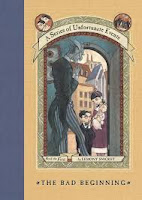
A Series of Unfortunate Events by Lemony Snicket 
Some people really like these books, and some people quite detest them.  I loved them as a child, even though the plots are quite repetitive: the Baudelaires, our three young orphan protagonists are pursued by the evil Count Olaf, who takes on all sorts of disguises and invents all kinds of evil plots in order to kidnap the children and steal their family fortune.  The "unfortunate events" these children encounter are truly dark and frightening situations, which is one reason why some people so vehemently dislike the books (the other is that pretty lackluster movie starring Jim Carrey, I guess).  But Klaus, Violet, and Sunny are the most resourceful young people imaginable, and always manage to save themselves, though usually at the cost of losing their clueless adult caretakers or acquaintances to Olaf's machinations.  Oddly, I just realized that these books have had a huge influence on me that I had never considered before.  The Baudelaire children begin maintaining commonplace books, notebooks filled with quotations and important information, after the sixth book in the series.  I began writing in what is in effect a commonplace book last year, basically on a whim, and I have found that it has transformed everything about the way I read, write, and think for the better.  The author also uses and explains lots of great vocabulary words (along with such unique insults as "cakesniffers") in each book, so this series is actually educational as well.  Those who were disappointed with the 2004 film will be pleased to know that the series is being adapted into a television series starring none other than Neil Patrick Harris as Count Olaf!  The first episode is scheduled to air in August, and I cannot wait!

Wow, this post has ended up being a bit long, but I did enjoy reminiscing!  I'd love to read what you remember or think about these books from my (er, and a lot of other people's) childhood, and please feel free to leave the link to your own top ten list so I can check it out.

Related Posts Plugin for WordPress, Blogger...