

Published: 1859
Pages: 670 (paperback)
Synopsis: The Woman in White famously opens with Walter Hartright's eerie encounter on a moonlit London road. Engaged as a drawing master to the beautiful Laura Fairlie, Walter is drawn into the sinister intrigues of Sir Percival Glyde and his 'charming' friend Count Fosco, who has a taste for white mice, vanilla bonbons and poison. Pursuing questions of identity and insanity along the paths and corridors of English country houses and the madhouse, The Woman in White is the first and most influential of the Victorian genre that combined Gothic horror with psychological realism.
Review:
I recently gave in to re-reading temptation and revisited one of my all-time favorite novels, The Woman in White.
I first picked up the book after one of my professors showed our class five minutes of a clip from the film version which stars Andrew Lincoln (Rick from The Walking Dead). In the scene we watched Marion Halcombe, looking wan yet determined in her rain-soaked pale nightgown, climbs across a narrow ledge outside her second story window in order to eavesdrop on the conversation of her sister's cruel husband Percival Glyde and his friend, the Italian Count Fosco, on the patio below. Marion edges along the ledge past a window and only just avoids being spotted by a severe-looking woman who appears in the window to draw the curtains. She then manages to overhear enough of Glyde and Fosco's conversation, despite the noise of the rain, to ascertain that her sister Laura is in terrible danger from some scheme the two men are planning in order to steal her inheritance. Fosco drinks two glasses of sugar water and the rain increases so that Marian can hardly hear what the men are saying or keep from slipping on the ledge... A rattled Marian eventually manages to return to her bedroom, but alas falls ill from having been so long out in the rain. Caught in a feverish sleep for days, she is unable to warn Laura of the danger she faces.
 |
| Walter Hartright encounters the woman in white |
While the film is in many respects different from (and inferior to!) the book, this scene was more than enough to pique my curiosity. I wanted to read about this brave and almost reckless heroine Marian, who seemed so different from the passive women in some other Victorian novels, and to find out about this diabolical scheme to steal her sister's fortune. I also wanted to learn more about the machinations of Count Fosco and his incongruous love of sugar. The Woman in White was therefore a book that I commenced reading both with very high expectations and a strong feeling that I was going to love this book. Approximately three years and four re-reads later, I can confirm that the powers of this suspenseful "sensation novel," written in 1859, have indeed stood the test of time.
Like Dracula, which it predates by several decades, The Woman in White is an epistolary novel. The story is told through the written accounts of different characters, chiefly Walter Hartright and Marian Halcombe. However, Laura Fairlie's family lawyer, her hypochondriac and misanthropic uncle Frederick, and even one of the villains also take their turn at narrating. Each of the characters has a unique and engaging style of narration and, like his better-known colleague Charles Dickens, Collins did not scruple to give them all interesting quirks or to pair humor with dire situations.
Count Fosco is one of my favorite Victorian villains. A far cry from the archetypal Gothic villain who twirls his mustache and rides a black horse, Fosco is an elderly and extremely fat Italian gentleman. He delights in taking care of his beloved pets, little white mice and parakeets. His wife seems to adore him, he stands up for Marian and Laura on several occasions, has impeccable manners, and absolutely loves the opera. His words and his character are such that at times even the reader, like Marian, wonders if they haven't terribly misjudged the Count.
I adore that very forthright and intelligent Marian Halcombe. She is not merely determined to win or be won by a suitor, or to passively survive the machinations of the villains, but to protect her sister and foil the schemes of those who would threaten her. She is fearless and determined when facing villains who can wield all the advantages, granted to them by their gender, of education, power, and wealth against her.
Said schemes and the plot twists of the novel are masterfully executed. While I own that I am the worst at guessing plot twists or mystery murderers, The Woman in White is riddled with surprises. Even while reading it for a fourth time, I found myself wondering "How in the world are the heroines going to get out of this situation??" The mysterious and titular woman in white is also not who I expected her to be. Though this is not a ghost story, she and the other characters are certainly haunted by their pasts.
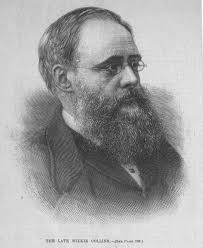 |
| Wilkie Collins |
I really cannot recommend The Woman in White enough. Marion is one of my favorite narrators in any novel, and she and the other characters greet me like old, eccentric friends whenever I revisit this book. Wilkie Collins' writing style is one that never fails to engage and delight and he succeeds in creating the eerie Gothic mood one might expect from this sort of novel. The novel is from start to finish so suspenseful that I imagine any reader would have difficulty putting it down for more than a few minutes at a time. My only complaint is that it tends to overshadow other classic thrillers that I read. Just as I and many other readers are still searching for the next best fantasy series to Harry Potter, I am still searching for the Victorian thriller that is nearly as good as The Woman in White!
Some favorite quotes:
"The best men are not consistent in good--why should the worst men be consistent in evil?"
"Any woman who is sure of her own wits, is a match, at any time, for a man who is not sure of his own temper."
...and the best of Frederick Fairlie (Laura's hypochondriac uncle):
"I sadly want a reform in the construction of children. Nature's only idea seems to be to make them machines for the production of incessant noise."
"I am a bundle of nerves dressed up to look like a man!"
This book is
suspenseful, extremely well-written, populated with memorable and likable characters


