Showing posts with label favorites. Show all posts

Wednesday, June 8, 2016

The Woman in White by Wilkie Collins

Genre: classic novel
Published: 1859
Pages: 670 (paperback)

Synopsis: The Woman in White famously opens with Walter Hartright's eerie encounter on a moonlit London road. Engaged as a drawing master to the beautiful Laura Fairlie, Walter is drawn into the sinister intrigues of Sir Percival Glyde and his 'charming' friend Count Fosco, who has a taste for white mice, vanilla bonbons and poison. Pursuing questions of identity and insanity along the paths and corridors of English country houses and the madhouse, The Woman in White is the first and most influential of the Victorian genre that combined Gothic horror with psychological realism.

Review:

I recently gave in to re-reading temptation and revisited one of my all-time favorite novels, The Woman in White.

I first picked up the book after one of my professors showed our class five minutes of a clip from the film version which stars Andrew Lincoln (Rick from The Walking Dead).  In the scene we watched Marion Halcombe, looking wan yet determined in her rain-soaked pale nightgown, climbs across a narrow ledge outside her second story window in order to eavesdrop on the conversation of her sister's cruel husband Percival Glyde and his friend, the Italian Count Fosco, on the patio below.  Marion edges along the ledge past a window and only just avoids being spotted by a severe-looking woman who appears in the window to draw the curtains.  She then manages to overhear enough of Glyde and Fosco's conversation, despite the noise of the rain, to ascertain that her sister Laura is in terrible danger from some scheme the two men are planning in order to steal her inheritance.  Fosco drinks two glasses of sugar water and the rain increases so that Marian can hardly hear what the men are saying or keep from slipping on the ledge...  A rattled Marian eventually manages to return to her bedroom, but alas falls ill from having been so long out in the rain.  Caught in a feverish sleep for days, she is unable to warn Laura of the danger she faces.
Walter Hartright encounters the woman in white

While the film is in many respects different from (and inferior to!) the book, this scene was more than enough to pique my curiosity.  I wanted to read about this brave and almost reckless heroine Marian, who seemed so different from the passive women in some other Victorian novels, and to find out about this diabolical scheme to steal her sister's fortune.  I also wanted to learn more about the machinations of Count Fosco and his incongruous love of sugar.  The Woman in White was therefore a book that I commenced reading both with very high expectations and a strong feeling that I was going to love this book.  Approximately three years and four re-reads later, I can confirm that the powers of this suspenseful "sensation novel," written in 1859, have indeed stood the test of time.

Like Dracula, which it predates by several decades, The Woman in White is an epistolary novel.  The story is told through the written accounts of different characters, chiefly Walter Hartright and Marian Halcombe.  However, Laura Fairlie's family lawyer, her hypochondriac and misanthropic uncle Frederick, and even one of the villains also take their turn at narrating.  Each of the characters has a unique and engaging style of narration and, like his better-known colleague Charles Dickens, Collins did not scruple to give them all interesting quirks or to pair humor with dire situations.

Count Fosco is one of my favorite Victorian villains.  A far cry from the archetypal Gothic villain who twirls his mustache and rides a black horse, Fosco is an elderly and extremely fat Italian gentleman.  He delights in taking care of his beloved pets, little white mice and parakeets. His wife seems to adore him, he stands up for Marian and Laura on several occasions, has impeccable manners, and absolutely loves the opera.  His words and his character are such that at times even the reader, like Marian, wonders if they haven't terribly misjudged the Count.

I adore that very forthright and intelligent Marian Halcombe.  She is not merely determined to win or be won by a suitor, or to passively survive the machinations of the villains, but to protect her sister and foil the schemes of those who would threaten her.  She is fearless and determined when facing villains who can wield all the advantages, granted to them by their gender, of education, power, and wealth against her.

Said schemes and the plot twists of the novel are masterfully executed.  While I own that I am the worst at guessing plot twists or mystery murderers, The Woman in White is riddled with surprises.  Even while reading it for a fourth time, I found myself wondering "How in the world are the heroines going to get out of this situation??"  The mysterious and titular woman in white is also not who I expected her to be.  Though this is not a ghost story, she and the other characters are certainly haunted by their pasts.
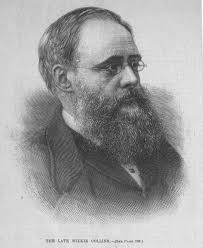
Wilkie Collins

I really cannot recommend The Woman in White enough.  Marion is one of my favorite narrators in any novel, and she and the other characters greet me like old, eccentric friends whenever I revisit this book.  Wilkie Collins' writing style is one that never fails to engage and delight and he succeeds in creating the eerie Gothic mood one might expect from this sort of novel.   The novel is from start to finish so suspenseful that I imagine any reader would have difficulty putting it down for more than a few minutes at a time.  My only complaint is that it tends to overshadow other classic thrillers that I read.  Just as I and many other readers are still searching for the next best fantasy series to Harry Potter, I am still searching for the Victorian thriller that is nearly as good as The Woman in White!

Some favorite quotes:

"The best men are not consistent in good--why should the worst men be consistent in evil?"

"Any woman who is sure of her own wits, is a match, at any time, for a man who is not sure of his own temper."

...and the best of Frederick Fairlie (Laura's hypochondriac uncle): 

"I sadly want a reform in the construction of children.  Nature's only idea seems to be to make them machines for the production of incessant noise."

"I am a bundle of nerves dressed up to look like a man!"

This book is

suspenseful, extremely well-written, populated with memorable and likable characters

Wednesday, June 1, 2016

Northanger Abbey by Jane Austen

Genre: classic
Published: 1817
Pages: 250

In her first novel Northanger Abbey, Jane Austen defends fiction in a manner that any ardent reader can not but highly approve of and applaud:

“It is only a novel... or, in short, only some work in which the greatest powers of the mind are displayed, in which the most thorough knowledge of human nature, the happiest delineation of its varieties, the liveliest effusions of wit and humor, are conveyed to the world in the best-chosen language.”

Northanger Abbey is definitely such a novel, though it seems to be sadly underrated compared to other Austen novels.  What it may lack a little in page count and dynamic secondary characters, in displaying "the most thorough knowledge of human nature," it more than makes up for in "the liveliest effusions of wit and humor."  Here Austen employed her usual candid wit to satirize not only certain elements and stock figures of English high society, but also the lurid Gothic romances like The Monk that were the bestsellers of her day.  The result is marvelously entertaining to read and often very funny.

Seventeen year old Catherine Morland is considerate and vivacious, a devoted reader of Gothic romances and a life-long country dweller.  When she has the opportunity to travel to Bath with family friends and spend a few months taking tea in gathering rooms and dancing with eligible young men, Catherine jumps at the chance, though she knows little of the manners of high society.  However, as Austen's omniscient narrator explains, Catherine's unworldliness can only work to her advantage in the game of attracting a suitor:

"She was heartily ashamed of her ignorance.  A misplaced shame.  Where people wish to attach, they should always be ignorant.  To come with a well-informed mind, is to come with an inability of administering to the vanity of others, which a sensible person would always wish to avoid.  A woman especially, if she have the misfortune of knowing any thing, should conceal it as well she can."

One can easily imagine Jane's sardonic smile as she put that last line to parchment.
Sketch of a pump room or gathering room in Bath

Catherine initially feels as if she knows no one in Bath, but luckily makes the acquaintance of a certain Mr. Henry Tilney, a clever and charming young man whom she quickly falls in love with.  Like any heroine, however, Catherine is beset by countless obstacles.  Isabella, another of her new friends in Bath must insist on carrying on in an embarrassing way with Henry's less pleasant elder brother, though she is engaged to marry Catherine's brother!  Likewise, Isabella's odious brother John has made up his mind that he is going to marry Catherine, despite the latter's indifference to his pathological lying and scheming.  Happily, Catherine is able to escape this intricate and embarrassing situation in Bath after Mr. Tilney and his sister invite her to sojourn at their family home, Northanger Abbey.  Catherine is delighted with the abbey and with her hosts...except for General Tilney, Henry's father.  As she learns more and more about the sudden death of the late Mrs. Tilney at Northanger Abbey, Catherine begins to suspect that the highly suspicious General poisoned his wife, or else is hiding her away in some secret passage...

Some readers have complained that the love interest Mr. Tilney is no Mr. Darcy or that he is a bit of a 2-D character, but I actually found him to be pretty nearly as well-written as Catherine and just...likable.  Fancy that, a love interest being kind and likable instead of going to incredible pains to convince the heroine that he hates her in order to disguise his great passion, or being some "bad boy" that the heroine has to work to redeem!  It makes for a nice change.  I particularly like his first conversation with Catherine, in which he ironically recollects after talking with her a while that he has forgotten to ask her all the stereotypical small-talk questions about how she likes Bath:

"...forming his features into a set smile, and affectedly softening his voice, he added, with a simpering air, "Have you been long in Bath, madam?"
Catherine and Henry Tilney in the 2007 Northanger Abbey film

"About a week, sir," replied Catherine, trying not to laugh.

"Really!" with affected astonishment.

"Why should you be surprised, sir?"

"Why, indeed?" said he, in his natural tone--"but some emotion must appear to be raised by your reply, and surprise is more easily assumed, and not less reasonable than any other."  

I also enjoyed the conversations in which Henry playfully parodies Catherine's expectations that Northanger Abbey will be a haunted Gothic monastery filled with relics of the horrible murders which have taken place there, inventing a whole story about her frightening discovery of a secret passageway.  However, I guess I cannot quote every passage that I loved here!

Just as Catherine Morland must eventually confess to having been influenced by her insatiable love for reading Gothic romances to judge people before getting to know them, I must confess to having been influenced by my love for Northanger Abbey!  After reading it for the first time a few years ago, I determined that I absolutely must read some of these "horrid novels" that Catherine and her friend Isabella thrill over in the book.
Delightful Penguin cover for The Monk
I haven't managed to get through the infamous The Mysteries of Udolpho, whose beginning didn't inspire a lot of interest.  However, I have read Matthew Lewis's The Monk, Horace Walpole's The Castle of Otranto, Lady Audley's Secret by Mary Elizabeth Braddon, and a number of Gothics by Wilkie Collins, primarily to see if they were as silly as Austen suggests in Northanger Abbey.

My verdict is that yes, Gothic romances can be ridiculous and long-winded, but they are also thrilling and suspenseful and delightfully convoluted, a bit like soap operas.  I have no trouble understanding why Catherine and Henry might burn the midnight oils to finish these tales of wronged ghosts seeking revenge, wide-eyed heroines, wicked foreign counts, and unpleasant housekeepers, all set in the most imposing and medieval of architectural structures.  Austen's book is a satire of the Gothic thriller, certainly, but as an unabashed fan of the much-maligned genre, I also appreciate her homage to it by way of clever parody.  I hope to read more Gothic romances of the sort that Catherine might have encountered soon.  As a graduate student studying that period, I can half-convincingly claim them as necessary reading, and I really want to give Ann Radcliffe another chance!

Rating:
5/5 stars

This book is one I selected for my Classics Club challenge list.  Fortunately, I am off to a pretty good start and have not neglected reviewing the books I read thus far.  I am still working on my review for The Awakening--it is turning out to be a difficult book to review!


Tuesday, May 17, 2016

And Then There Were None by Agatha Christie

Genre: suspense, mystery
Pages: 264 (paperback)
Published: 1939

Synopsis: 
First, there were ten - a curious assortment of strangers summoned as weekend guests to a private island off the coast of Devon. Their host, an eccentric millionaire unknown to all of them, is nowhere to be found. All that the guests have in common is a wicked past they're unwilling to reveal - and a secret that will seal their fate. For each has been marked for murder. One by one they fall prey. Before the weekend is out, there will be none. And only the dead are above suspicion.

Review:

It's strange to think that I had never read a single Agatha Christie novel before deciding, on a whim yesterday, to pick up And Then There Were None.

I generally will read every genre with the notable and pretty strict exceptions of romance and mystery.  In the case of mystery, I have to admit that part of my prejudice stems from my utter lack of skill in predicting "whodunit" or what will happen next.  I so do not find it elementary, Watson, and frankly, this is partially a result of the way I operate as a reader.  I'm not a speed reader of the kind that you can find on Youtube, apparently absorbing whole books at the rate of five seconds a page.  However, I do read quite quickly and I read for information, purposefully picking out the most necessary bits on every page and somewhat skimming over the little details.  But in mystery novels it is these little details that matter the most, and this is definitely the case with And Then There Were None.  Tiny details of setting and dialogue that Christie briefly alights on turn out to be key to the twists and turns of the plot.  Even as a reader generally uninterested in the genre, I found myself captivated by the book and appreciative of her mad skills--truly, Christie was the "Queen of Mystery."

I also appreciated that this is not at all a detective story in the usual sense.  There is no central detective figure trying to wrap up the mystery of a previously-committed murder, but rather the murders are happening in the present.  Readers who share my aversion to mystery and detective stories but embrace horror will enjoy the sense of suspenseful inevitability of the murders on Indian Island, a sense created not only by the title And Then There Were None (note: the novel was originally published as Ten Little N******; click the link to read an article about the racist title's evolution through the years) but by the device of the morbid nursery rhyme which each of the characters find posted in their rooms upon arriving at the empty house on Indian Island.  The murders of the guests adhere strictly to this rhyme about "ten little Indians," so that we have a rough idea of how the next victim will die, but now when or who the victim will be.  For example, the rhyme declares, "Six little Indians playing with a hive; A bumblebee stung one and then there were five."  Just as in a number of good horror films, apparently childish things or nonsensical rhymes turn on to have a eerie power of life and death over the characters.

As far as the characters, one among the ten people on Indian Island is presumed to be the murderer, causing all these gruesome deaths that accord with the creepy nursery rhyme.  The rest of the guests  are essentially accused of murder by a mysterious disembodied Voice who terrifies them by announcing their respective crimes during their first evening in the island house's sitting room.  Taken together, these two facts kind of discourage the reader from getting too attached to any of them, and the novel is plot-driven to say the least even though knowing the characters is central to figuring out what is going on.  Christie does a good job characterizing the island guests considering that her writing is pretty sparse, and so is the dialogue.  We quickly see that Philip Lombard is cold-blooded like a character out of Heart of Darkness, Vera Claythorne is smart and intuitive, and Emily Brent is one of those well-meaning but frustrating ladies who thinks of herself as a living saint.  As always, I was completely stumped by the question of who the murderer might be!  All of my speculations turned out to be wrong, and the revelation at the end relies on a wild and ingenious twist which I don't think even many readers better-versed in the mystery genre would guess if they weren't already familiar with the story.      

The novel is absorbing and fast-paced, the sort of book that appeals to a huge variety of readers.  One can see why it has been adapted into so many films and series and plays over the years.  As usual, though, nothing can be better than reading the original novel and spending a few hours of a rainy day appreciating Christie's craft and the diabolical eeriness of it all, watching the twisted nursery rhyme play out.

I wholeheartedly recommend this classic suspense story and intend to pick up another Christie book soon, although I don't know which one.  She wrote so many!  I must be in the mood to scare myself to death by reading about old, haunted, secluded houses and the ghosts and murderers and madpeople in the attic who inhabit them, because I've also just started reading Stephen King's Bag of Bones and have contemplated yet another reading of Jane Eyre.

Rating:


Monday, April 25, 2016

Saga by Brian K. Vaughan and Fiona Staples (artist)

Genre: graphic novel, science-fiction
Pages: 160  
Published: 2012

Synopsis:
When two soldiers from opposite sides of a never-ending galactic war fall in love, they risk everything to bring a fragile new life into a dangerous old universe. 

From bestselling writer Brian K. Vaughan, Saga is the sweeping tale of one young family fighting to find their place in the worlds. Fantasy and science fiction are wed like never before in this sexy, subversive drama for adults. 

Note: This review is for volume one, but my opinion of the series has been influenced by the fact that I've just finished volume two.

Review:
Strangely enough, I had harbored a vague desire to start the Saga series ever since it started appearing at the top of "Best New Graphic Novels" and "Best Sci-fi" lists on Goodreads a few years ago.  I think most of my initial hesitation stemmed from the fact that the cover of this first volume is a bit odd; it features alien breast-feeding.  (Admittedly, the cover for the forthcoming Book One collection is even less subway-commute-friendly). 

 In retrospect, I am so glad I overcame my shallow scruples.  Truly, never judge a book by its cover!  Saga is one of the most sophisticated, psychologically complex, ridiculously readable, and funny series that I have read in my long career as a bibliophile.  After finishing this first volume, I returned to the bookstore and splurged on the next four volumes--an unheard-of thing for me, since I tend to avoid buying brand-new books for my library unless I absolutely have to own them.  Well, I absolutely had to purchase the Saga series, because I quickly realized that these are graphic novels I will want to reread and flip through again and again.   

Our protagonists are Marco and Alana, a recently and happily married couple.  Unfortunately, their love is star-crossed to say the least: their two home planets (Marco's home world being a moon, technically-speaking) have long been locked in a fierce war and Marco and Alana, as former soldiers, have both betrayed their respective armies and planets by deserting and running away together.  
At the start of the series, their little family of misfits on-the-run gains a new member when Alana gives birth to a baby girl, Hazel.  I adored the evolving, complex, and genuinely lovely relationship between Marco and Alana and especially their early adventures in parenting the newborn Hazel.  Unfortunately, most of the rest of the cast of Saga are not feeling the love, and so the new family must constantly flee from danger.   


The governments of Marco and Alana's respective planets are eager to kill the lovers before the masses find about their treasonous and interspecies relationship (both sides are indoctrinated from a young age to loathe and dehumanize their enemies), and they are also keen to get their hands on Hazel.  Among the seemingly endless assortment of characters who seek to murder Alana and Marco and kidnap their child are the prince of a robot kingdom (no Prince Charming, he; he has a television monitor for a head, a frightening case of PTSD, and an arm which can transform into a cannon), an assassin (endowed with the strange moniker "The Will" and always accompanied by his beloved Lying Cat, a large feline who can detect when a person is lying), and another fierce contract killer with whom the aforementioned assassin is hopelessly in love.  This anatomically interesting individual (pictured left) is called "The Stalk."  As much as I enjoyed Alana and Marco's storyline, I also loved every panel featuring the two assassins.  Admittedly, intergalactic assassins have been an enduring interest of mine ever since I first saw the sangfroid, awesomely-outfitted Boba Fett in Star Wars.  These two are really well-developed characters, especially The Will, and once Saga is complete, I totally think that Brian K. Vaughan and Fiona Staples should create a spin-off series featuring the assassins, the organization who gives them contracts, and their adventures before they begin hunting Alana and Marco.  

While the series is so original that it largely eludes comparisons, Saga does incorporate some of the same elements which can be found in the immortal Star Wars--morally ambiguous and intensely likable characters, spaceship pursuits across the galaxy, diverse alien species, and, not least, its sense of humor.  

My favorite character--if I must pick just one--is certainly Alana, whose wit also provides much of the comic relief of the series. 
This young woman is fiercely protective of her family and a tough fighter, but also obsessed with this one book where not many things actually happen, but the characters hang out and talk about philosophy and random things.  It sounds a bit like An Imperial Affliction, the book with which Hazel is obsessed in The Fault in Our Stars, only not about cancer and less depressing.  As a book lover, I related to this.  Also, again, Alana is funny.  Her dialogue is riddled with ironic quips and the kind of snarky remarks that everyone else only wishes they were able to think up on the spot.  (Personally, I usually come up with that perfect wry observation or comeback in the middle of the night five days after the occasion in which I might have employed it.  *Sigh.*)   I adored Marco as well, and Hazel--who, despite being only a few days old during the actual action, is the narrator of the story--but Alana and The Will (one of the assassins) were really the stand-out characters among a stand-out cast of characters, for me.

Finally, the art of this series is really spectacular.  While Vaughan's writing brims with sheer humanity and his plot focuses on universal themes of love, warfare, family, and blurred moralities, Fiona Staples depicts a colorful, outlandish galaxy in which few things are familiar or comfortable for the reader.

  While some of the panels may seem bizarre or off-putting to the average reader who flips through the first volume's pages, the story and the characters are such that I feel they will immediately captivate anyone who gives this graphic novel a fair chance. 


Rating:


Thursday, May 9, 2013

The Turn of the Screw by Henry James

Genre: Gothic/Victorian
Pages: 172 (paperback)
Published: 1898


Synopsis:
Henry James, a master of haunting atmosphere and riveting tension, presents one of the most famous ghost stories of all time. A young governess is sent to a country home to take charge of two orphans, and unsettled by a sense of intense evil within the house, becomes obsessed with the belief that malevolent forces are stalking the children in her care. Growing increasingly uneasy, she becomes drawn into a frightening battle against an unspeakable evil that may or may not be real.
 
Review:
 I was almost entirely unfamiliar with this admittedly well-known classic ghost story before reading The Turn of the Screw. I've seen the Nicole Kidman movie it inspired, The Others, but otherwise came into this not knowing what to expect.  The Woman in Black (which I someday might review) is one of my favorite short horror novels.  It isn't Victorian, but it is set in that time period and shares some of the same eerie psychological horror with Turn of the Screw-- but this little book turned out to be far better.

So, the story is a story within a story-- a guy at a party tells a story about a ghost story which he has written down by a woman he once knew to someone, presumably Henry James.  So, metafiction-- and for the rest of the book this doesn't come up again.  The protagonist and first-person narrator after the prologue is a young governess, the daughter of a parish priest.  She goes to the country estate of Bly (and how might one pronounce this??) to take care of two children at the behest of their always-absent-on-business uncle.  We never learn this governess's name or much about her, already evoking a sense of mystery and, well, vagueness. 

The two children, Flora and Miles, who the governess must look after fit the Victorian ideal of children: they are angelic in both appearance and behavior, bright and determined to please.  Our narrator is happy in her new position-- until she begins to see a strange man, a man who she instinctively feels to be evil, around the grounds of Bly. 
When she tells the housekeeper what she has seen, the terrified woman identifies the man by the governess's description: he is Peter Quint, a man who once worked for the estate and who apparently spent a lot of time with young Miles.  Soon after the terrifying appearance of Quint, a second ghost-- the ghost of the governess's predecessor at Bly-- appears.  The governess, never once doubting her instinctual feeling that these apparitions want nothing more than to hurt her innocent young charges, seeks a way to protect them from the spectors and the corruption she associates them with.  

I don't think it is much of a spoiler to add that there are two main readings of The Turn of the Screw, as you might guess from just reading the synopsis: A. this is a true ghost story, and the governess, having perfectly identified the ghosts of people she had never met, is correct in that these spectors are trying to lead the children to their own deaths (and possibly corrupt them as well).  Reading B: the governess is paranoid, to the point of halluncinating the apparitions, and possibly insane; she creates malevolent figures where in fact there are none, for various psychological reasons.  I lean towards reading B, though I don't have a satisfying explanation for how the governess knew what Quint and Miss Jessel, the other ghost, looked like.  The character of Mrs. Grose-- the housekeeper-- seems suspect in this: maybe she matched the governess's vague descriptions of the apparitions to those of Quint and Jessel because she had always thought them to have sinister intentions.  The thing is, there are several occasions when the governess sees the ghosts and points them out hysterically to the children or to Mrs. Grose, and nobody else sees anything.  Maybe a "meeting point" between the two readings is that Jessel and Quint did corrupt the two children-- the boy and the girl-- before their deaths, and their dark influence lingers, though they are not ghosts, in the sometimes bizarre behavior of the children.  Miles in particular turns out to be much less angelic than he first appears to be...

The governess's conviction towards the nature of the ghosts has the reverse effect of causing the reader to be skeptical of their existence.  Anyway, so I really enjoyed this book.  And yet, halluncinations or not, these ghosts are more frightening to me than the ones which populate 21st century horror movies.  The description of the "pale face" of the ghost of Quint looking in through the window at the children having dinner is beyond eerie-- oh, that scene beat out only by the one with Miss Jessel by the governess's writing desk!  And I feel like I'm spewing spoilers again, but point being, there are some truly eerie scenes.  

The Turn of the Screw succeeds as a ghost story and as an interesting character study...the ambiguity of the supernatural elements and the governess's identity is great and, actually, a little bit maddening.  The ending came as a shock to me, to say the least.  Not sure how I missed the million BBC adaptations of this, but I'm glad I did-- this thin pageturner packed with heavy ambiguity and a great deal of creepiness was a unique reading experience.

My rating:


Wednesday, March 6, 2013

The Graveyard Book by Neil Gaiman

Genre: children's/ MG fantasy
Pages: 312 (hardcover edition)
Published: 2008 by HarperCollins

Synopsis: 
After the grisly murder of his entire family, a toddler wanders into a graveyard where the ghosts and other supernatural residents agree to raise him as one of their own.  Nobody Owens, known to his friends as Bod, is a normal boy. He would be completely normal if he didn't live in a sprawling graveyard, being raised and educated by ghosts, with a solitary guardian who belongs to neither the world of the living nor of the dead. There are dangers and adventures in the graveyard for a boy. But if Bod leaves the graveyard, then he will come under attack from the man Jack—who has already killed Bod's family . . .
Review:

Well, I am one of those people who likes Neil Gaiman.  It seems like about half of readers love this guy's books to death from the first page-- they say things like he's an ultra-imaginative, clever genius, one of the most enchanting writers of our age.  The other half tend to come to the conclusion that he's a little overrated, or that his stories are too confusing to follow, a little dark, and just plain weird.  I totally agree with Gaiman's critics: his short stories more than his novels can lean towards bizarre, but I think he's a genius anyway.  What I like most about his novels is how he takes a fantastical plot or setting (in this case, a graveyard) filled with unusual and often mysterious characters (here, a whole host of ghostly inhabitants and Bod's guardian Silas, a man who is neither alive nor dead) and weaves a brilliant, entertaining, and surprisingly believable story about human values and life.  Yep, he is a genius in my eyes.

The Graveyard Book is a coming-of-age story whose premise is loosely based on Rudyard Kipling's The Jungle Book.  After an assassin called the man Jack murders his parents and sister, Bod is taken in by a long-dead couple who live in the cemetery by his old house.  Bod learns to read from the engravings on tombstones, sleeps in a crypt, and his guardian is kind of a vampire-- but in all the important ways, he's still an ordinary boy, meaning that he really can't stay out of trouble.  He befriends a dead teenage witch from unconsecrated ground, goes into town to attend school (and gives the local bullies a little hell), and steals an ancient artifact from an ancient tomb where even the oldest ghosts don't dare to venture.  But when the man Jack, along with a shadowy league of assassins who have wanted Bod dead since he first disappeared into the graveyard, return to finish the job of murdering Bod's family, Bod will be forced to use every supernatural trick and bit of uncanny knowledge he has learned from growing up among the tombstones to defeat them.

The Graveyard Book is actually a somewhat cheerier tale than Coraline, Gaiman's other middle-grade-type book.  The premise of a boy whose family is murdered and grows up in a graveyard sounds darker than one about a girl who finds another world and another mother through a door in her apartment-- but it isn't.  The Graveyard Book is far lighter in tone and far less slightly disturbing than Coraline, because the ghosts and strange beings Bod meets are more well-developed, likeable, and generally benevolent characters than the creepy Other Mother and the denizens of Coraline.  My favorite part of the book-- other than the climactic and amazing ending-- is the story about the young girl Bod meets who was accused of being a witch and killed back in medieval times.  This dead girl, Liza Hempstock, was the first character Gaiman wrote about for the story besides Bod, and she is definitely one of the most memorable: she has a great sassy personality despite the way she died, yet her story is so sad.  Bod's quest to find a proper headstone for this girl is a bittersweet and amazing sub-plot in the story. 

The Graveyard Book, along with all of other Neil Gaiman's other books for children and middle-grade readers, is definitely one I would want my future daughter read.  The story is also subtle enough that adults can read it and enjoy the nostalgic feelings of childhood which are strong in Bod's story despite the unusual nature of his childhood.  Fascination with a strange and sinister-seeming neighbor, being babysat by unlikely and ill-qualified candidates, spending the day with a new, quickly-made friend and having to say goodbye too soon, sneaking off to forbidden places... like Mowgli's, Bod's story is one we can relate to despite the strangeness of his circumstances.  I can't recommend this book enough, for children, teens, and adults.  Now, I want Neil Gaiman to hurry up and release his next novel The Ocean At the End of the Lane-- which comes out on my birthday!

Book Rating:


Saturday, December 1, 2012

The Hobbit by JRR Tolkien

Genre: high fantasy
Pages: 330 (this paperback edition)
Published: 1937 (but republished many, many times)


My Take:

Keeping in mind that this book is no Lord of the Rings (one of my first fantasy obsessions), I really enjoyed this book.  The Hobbit has a charming, kind of Old World feel to it-- I kept thinking how very British Tolkien's writing is.  (Not that there's anything wrong with that-- I love Britishness.  Harry Potter is British.  So is Doctor Who.  And Neil Gaiman.  All very wonderful things.)


 Bilbo Baggins is a typical hobbit in many ways: he enjoys the occasional parties and house guests (as long as those guests don't overstay their welcome); and he is generally very comfortable in his Hobbit-hole and cares little for adventures of the fantastical or unusual sort, thank you very much.
But then the fabled wizard Gandalf the Grey enlists the reluctant Bilbo to accompany him and a troupe of thirteen dwarfs to the faraway Misty Mountains, where they hope to steal back legendary dwarven treasures from the very old and very wicked dragon, Smaug, who slumbers in a high mountain amongst his hoard of treasures.
 Bilbo, Gandalf, and the dwarfs travel far across Middle-Earth, through deep forests where millions of tiny eyes watch them from the trees at night.  They stay in the house of a shapeshifter and in the ancient house of Elrond and the elves and are not entirely roasted, boiled, or fried by a trio of trolls. 
Alone and hiding from goblins in the depths of a watery cave, Bilbo engages in a deadly game of riddles with the strangest and most sinister of beings: the creature which we will come to know as Gollum.  From Gollum he wins a beautiful ring, a ring of power and magic which can help its wearer turn invisible at will, but can also cast a dangerous spell over its owner.  In the end, there is a great battle as the people whose villages the dragon has devastated for so long attempt to take vengeance against Smaug at last...and Bilbo proves to be a far more valuable addition to the company of dwarfs and wizard than he would ever have expected.

Anyway, I enjoyed doing that-- nice way to liven up a book review with pretty pictures.  I loved the illustrations in my edition of The Hobbit, and definitely recommend that edition: the cover is so colorful and the style of the little patchwork drawings perfectly pits this book.  The Hobbit is a wonderful read: a good book for savoring and definitely one for reading aloud to kids, if you have kids or little siblings, etc.

The only thing that bothered me about the book wasn't about the book at all: it's how in the world Peter Jackson is going to make this barely 300 page book into a three-part movie series!  How will that work, exactly?...One movie about the party in the beginning, one about the journey, and one about a battle?  It seems like one Lord of the Rings movie might have more plot action than all three Hobbit movies put together.  I'm guessing the pace of these latest films will be a little more plodding... lots of beautiful shots of New Zealand.  But a creepy cameo by Gollum and a lot more Gandalf.  I've always really liked Gandalf (the Grey variety preferred), and wizards and wizardly hats in general.  Anyway, I'm glad I read this delightfully wonderful book, because it's made me even more excited for the upcoming film The Hobbit: An Unexpected Journey, which will premiere (yay!) on December 14th.

Book Rating:


Wednesday, October 24, 2012

Wolf Hall by Hilary Mantel

Genre: historical fiction
Pages: 532 (hardcover)
Published: 2009 by Henry Holt


Synopsis: In the ruthless arena of King Henry VIII’s court, only one man dares to gamble his life to win the king’s favor and ascend to the heights of political power England in the 1520s is a heartbeat from disaster. If the king dies without a male heir, the country could be destroyed by civil war. Henry VIII wants to annul his marriage of twenty years, and marry Anne Boleyn. The pope and most of Europe opposes him. The quest for the king’s freedom destroys his adviser, the brilliant Cardinal Wolsey, and leaves a power vacuum. Into this impasse steps Thomas Cromwell. Cromwell is a wholly original man, a charmer and a bully, both idealist and opportunist, astute in reading people and a demon of energy: he is also a consummate politician, hardened by his personal losses, implacable in his ambition. But Henry is volatile: one day tender, one day murderous. Cromwell helps him break the opposition, but what will be the price of his triumph? In inimitable style, Hilary Mantel presents a picture of a half-made society on the cusp of change, where individuals fight or embrace their fate with passion and courage. With a vast array of characters, overflowing with incident, the novel re-creates an era when the personal and political are separated by a hairbreadth, where success brings unlimited power but a single failure means death.
 Wolf Hall makes for a very unconventional historical fiction novel.  Not only does it reverse almost all of our long-held beliefs about the players of King Henry VIII's Tudor court, the style in which the book is written is incredibly refreshing.  No long-winded descriptions of tapestries and family histories here-- to the contrary, Mantel skips the exposition which many historical novels are so fond of and jumps right into the story, leaving us to work out the various relationships between characters.  Her very modern writing style and blunt, clever dialogue are likely two of many elements working skillfully together which has helped this bulky book (and its recent sequel, Bring Up The Bodies) to catapult onto the bestseller lists.

 This is the first book I've ever read which focuses on Thomas Cromwell, Henry VIII's infamously capable and manipulative chief minister.  In history and in modern fiction, he is traditionally portrayed as something of a villain, but here Cromwell is sympathetic, if only-- in my opinion-- the point-of-view character around which the better-known court dramas surrounding Henry VIII, his advisers, the Pope, and Anne Boleyn unfold.  Likewise Sir Thomas More, the conservative Catholic minister who was eventually executed for his opposition to Henry's divorce from Catherine of Aragon, is not a wise martyr in this book, but an unyielding radical who imprisons and tortures reformist thinkers and "heretics".  I have to say, I was always a fan of More, "The Man for All Seasons", particularly after watching the Showtime series The Tudors, in which he's portrayed as a kindly intellectual with a very cool hat.  Not so in Wolf Hall: here More is as ambiguous as Cromwell, but often much less than kindly.

King Henry VIII is a major player, of course, but I really liked Mantel's portrayal of Anne Boleyn especially.  She is a crafty woman, of course, but her conversations with Cromwell bring new perspective into what the personality of this siren-like lady may have been like-- she seems a little neurotic, always in control but also maybe a little bit mad. Other familiar characters from the Tudor era which make appearances include Catherine of Aragon, Henry's first wife who was de-throned in favor of Anne, her daughter Mary-- strange and emotionally unstable in this book--, the Dukes of Suffolk and Norfolk, the Cardinal Wolsey-- who was accused (probably correctly) of corruption--, and Mary Boleyn, Anne's sister. 

My pet peeve with this book is its title, because I don't think Cromwell ever visited Wolf Hall even once in the story.  (I'm pretty sure...?)  Wolf Hall was the Seymour house's traditional seat in England, and Jane Seymour herself is yet to be a major character or established on Henry's romantic radar.  Despite the misnomer title, I totally enjoyed this tome of a novel.  Despite its bulk, it turned out to be a rapid page-turner.  The next time you feel like tackling a 500+ page novel, look to Wolf Hall.   


My Rating:


Thursday, October 18, 2012

Favorite Children's and Middle-Grade Authors & Books

So, of all the genres I've reviewed and bragged on, I've hardly published a single post about the books which are most important to readers-- the books for children and middle-grade readers which first turned most of us on to reading.  So, I thought I'd feature some of the books and book series which were my favorites when I was younger and remain some of my favorites today.


The Harry Potter series by JK Rowling
To me and to the millions of other readers young and old who have fallen in love with Hogwarts and its students, Harry Potter is much more than kid-lit.  Nevertheless, I have to credit it with making me into such a voracious reader.  When I was seven or eight and had read through the first four Harry Potters, I set off on this quest to discover a book which I loved even half as much, a character I identified with as much as Hermione Grange, and a magical world even half as incredible.  I never did find one, and still haven't today, but the quest is what first made me such a frequent visitor to the library.  

The Children of the Red King series by Jenny Nimmo
Charlie Bone could be called the next best thing to Harry Potter, and so it was to its pages that my search took me next.  Charlie Bone becomes a student at the clandestine and exclusive Bloor's Academy, where artistically-talented students study alongside students with special powers, "the Endowed", a group of children descended from the mythical Red King.  The series is aimed at younger kids than Harry Potter, I would say, but the stories and the characters are incredible.  I believe there are now seven books, and the series is finally finished.
 The Chronicles of Narnia by CS Lewis
I think the magical world of Narnia is one best experienced when you're about the Pevensies' age: this is a happier literary place than Harry Potter's world, despite the White Witch and any number of goblins.  My favorite books in the series are: The Lion, The Witch, and the Wardrobe; Prince Caspian; The Horse and His Boy; and The Voyage of the Dawn TreaderThe Last Battle is sad and allegorical-- I could almost do without that one.

 The Inkworld Trilogy, The Thief Lord, and other books by Cornelia Funke
Inkheart became my new favorite book when I was ten or so: it was about a girl, Meggie, who could do exactly what I, a shy bookworm, wanted most: to travel into books and call up the characters from their pages into the real world, even to write her own stories into physical being.  I can't tell you how many times I read this book-- recently I saw a girl about the age I was when I first read it reading it for the first time, and I'm glad to see that it's still so popular.

 Matilda and other books by Roald Dahl
Matilda is another MG-lit heroine who loves books and has a magical power herself.  This book was another frequent re-read for me, and I also liked The Witches, Charlie and the Chocolate Factory, and The BFG.  I still have the Roald Dahl boxset on my bookshelf.  His books are true children's classics.

 The House of the Scorpion and other books by Nancy Farmer
The House of the Scorpion was maybe my first foray into science fiction, or good science fiction.  Anyone, pre-teen or adult, who reads this novel is bound to remember it and its haunting themes and ending forever.  The Sea of Trolls and its Norse-myth-based sequels are fantasy, but equally incredible.  I love the character of Thorgil and, of course, the elves and trolls.


The Wolves in the Walls, Coraline, Instructions, and others by Neil Gaiman
Yep, I discovered Neil Gaiman at a fairly young age.  Coraline was the first I read by him, and the story really impressed me-- it was so much eerier and better written than Goosebumps books, which were my first foray into horror.  I quickly devoured his picture books for younger children, as well... I only wish I'd gotten to read some of his newer books for younger people, like The Graveyard Book (which I read anyway, of course) and The Blueberry Girl when I was reading the others and wishing he had more for kids.  I loved Gaiman's writing style so much that I starting reading his adult books, like American Gods and Stardust.

Did ya'll ever read any of these books as children, teenagers, or as adults?  Which books from your childhood/pre-teenhood are the most memorable to you, or made you into the reader you are today?


Wednesday, September 5, 2012

The Night Circus by Erin Morgenstern

Genre: historical fantasy
Pages: 387 (paperback)
Published: September 2011 by Doubleday

Synopsis (from Goodreads): The circus arrives without warning. No announcements precede it. It is simply there, when yesterday it was not. Within the black-and-white striped canvas tents is an utterly unique experience full of breathtaking amazements. It is called Le Cirque des RĂªves, and it is only open at night.

But behind the scenes, a fierce competition is underway—a duel between two young magicians, Celia and Marco, who have been trained since childhood expressly for this purpose by their mercurial instructors. Unbeknownst to them, this is a game in which only one can be left standing, and the circus is but the stage for a remarkable battle of imagination and will. Despite themselves, however, Celia and Marco tumble headfirst into love—a deep, magical love that makes the lights flicker and the room grow warm whenever they so much as brush hands.

True love or not, the game must play out, and the fates of everyone involved, from the cast of extraordinary circus per­formers to the patrons, hang in the balance, suspended as precariously as the daring acrobats overhead. 


My Take: 
The Night Circus is like a mesmerizing performance written in short acts, chapters from different character perspectives and timelines which wind together to form a beautiful and intricate story.  The book itself has the feel of a very enchanting circus: along with the main show involving Celia and Marco, two young enchanters trained in two different schools of magic and made by their respective teachers to participate in a game to prove which is stronger, the reader is afforded brief glimpses into other circus tents. The subplots in this book are truly intriguing as well as relevant, and I'm discovering that some of the less-developed stories, like those belonging to the various circus performers and visitors,  are the ones which linger most potently in my mind.  I was captivated by the circus's mysterious contortionist, Tsukiko; by the tarot reader who helps to hold the fate of the circus in balance with a single card; by the German clockmaker who falls in love with the circus and becomes the first of its most ardent admirers, a reveur; and by the Murray twins, born on the circus's opening night and forever bound up in its web of magic and secrets.

This was a novel right up my alley in many ways: the Victorian elements paired with the subtle romance, a cast of characters with ambiguous motives and hidden depths, and of course, the magic.  It's so rare that a reader can become completely immersed in a fictional setting, but this is one of those unique books which helps us accomplish it.  Reading this spectacular novel, I can imagine with perfectly clarity what it would be like to walk down the chilly, winding roads of the Night Circus wrapped in a Victorian overcoat and a woolen red scarf, passing by black and white-striped tents and breathing in the scents of bonfires and caramel popcorn.  There are so few books with settings as lucid and characters as fully-realized as that of The Night Circus that I would be hard-pressed to come up with more than a couple more-- Hogwarts in the Harry Potter series as that kind of this-could-be-a-real-place feel, and maybe Narnia.  To successfully endow a book with that quality of perfect seamless immersive-ness is a kind of literary magic, the ultimate achievement in any genre, but particularly in fantasy.  I really wish there were more books in the world as beautifully-written and complex, yet sweet and simply intriguing, as this one.

My rating:


Related Posts Plugin for WordPress, Blogger...