Genre: play, comedy
Published: 411 BCE
Translated by Douglass Parker
The Peloponnesian War has raged between Athens and Sparta for many years. Lysistrata, an Athenian woman, becomes fed up with the devastating war and her husband's refusal to even speak with her about the possibility of peace:
Lysistrata: "...When the War began, like the prudent, dutiful wives that we are, we tolerated you men, and endured your actions in silence. (Small wonder--you wouldn't even let us say boo.)
Too many times, as we sat in the house, we'd hear that you'd done it again--manhandled another affair of state with your usual staggering incompetence. Then, masking our worry with a nervous laugh, we'd ask you, brightly, "How was the Assembly today, dear? Anything in the minutes about Peace?" And my husband would give his stock reply.
"What's that to you? Shut up!" And I did."
So Lysistrata comes up with a simple yet ingenious plan. She summons the war-weary women of Athens and some from Sparta as well and announces that they are going to force their husbands and lovers to end the war by refusing to have sex with them until they call an armistice. In the meantime, they will dress and perfume themselves as seductively as possible, wearing thin gowns and such, and the older women of Athens will seize and occupy the Acropolis.
I had somewhat high expectations for this play, having known it by reputation for a long time. When I was younger, I imagined it must be a sort of Grecian "battle between the sexes," which in a way, it kind of is. As I grew older and became more self-consciously a feminist, I assumed Lysistrata must be a feminist play, since it features women mobilizing together and wielding what power they have over men in a patriarchal society to bring about peace.
However, Lysistrata is first and foremost a comedy. It is not at all a feminist (or more accurately, proto-feminist) work. Although women are the agents of conflict and change in the play, none of Aristophanes' characters are what one might call proto-feminist. In fact, even the women in the play decry their own gender at times; Lysistrata laments that her comrades in the strike are so weak and useless. That said, she also does have a few stirring lines which assert her dignity and the dignity of her cause. "What did you expect?" she asks an Athenian commissioner who comes to try to persuade her and the other women to leave the Acropolis,
"We're not slaves; we're freeborn Women, and when we're scorned, we're full of fury. Never underestimate the Power of a Woman."
Other than this disappointment, which I perhaps should have been better prepared for (Ancient Greek playwrights are not known for having had a high regard for women), I did somewhat enjoy Lysistrata. Some scenes were funny, as when Myrrhine teases her husband by pretending to get everything ready for them to sleep together (bed, pillows, blankets, perfume, a better perfume, etc) and then running away. I also have to commend the translator (Douglass Parker, in the edition I read) for translating all of these sometimes obscure Greek sexual puns and double entendres into English, which cannot have been an easy task. That said, I avoid sex comedy films like the plague and found some of the humor here to be crude.
While the play is not itself feminist, I do think it is one that feminists and those who are interested in gender studies, gender and power, etc, should check out. Lysistrata and the other women are adamant that war affects everyone, not just warriors and not just males but also women and children and communities. While the story is a myth, the play demonstrates that anyone can change the course of history by promoting peace, even if one works to do so by means of apparently simple or, er, unorthodox methods. Also, phallic jokes are apparently timeless.
I was excited to see that one of my favorite fin-de-siècle artists Aubrey Beardsley actually created some striking illustrations for this play, but decided not to include any of them in this review because most of them are bordering on pornographic. I do not really know the age range of this blog's vast audience (haha), but back in the day I did have many younger readers. Anyway, though, I digress...
I am going to try reading another Aristophanes comedy, possibly The Frogs, which I have heard good things about.
This play is
bawdy raunchy (yes, I realize that is a synonym for "bawdy," but it bears repeating)
This play was on my Classics Club list!
Showing posts with label classics. Show all posts
Friday, July 1, 2016
Wednesday, June 29, 2016
The House of the Seven Gables by Nathaniel Hawthorne
Pages: 225
Published: 1851
This is a tale of a house cursed through the centuries by a man who was hanged for witchcraft--a house haunted by the ghosts of its dead and the terror of its living inhabitants. The blighted house controls the fates of four Pyncheons: Hepzibah, an elderly recluse; Clifford, her delicate brother; Phoebe, their young country cousin; and Jaffrey, a devil incarnate whose greedy quest for secret wealth is marked by murder and terrible vengeance from a restless grave.
I always intend to read more American literature. This week I have done pretty well, having read both a book of poems by Emily Dickinson and The House of the Seven Gables. The Dickinson poems were sublime; a gushing review of those is in the works. As for The House of the Seven Gables...
I loved Hawthorne's lovely way of writing, his skill in telling stories about the past inhabitants of the titular house and weaving them into the present story. I found the stories about the presumed witch Matthew Maule who cursed the Pyncheon family before his execution and the young, doomed Miss Alice Pyncheon to be mesmerizing, among the best parts of the book. I appreciated Hawthorne's great attention to detail in painting the images and personalities of the characters, who are few but memorable. I could just see Judge Jaffrey Pyncheon swinging his cane and smiling benevolently at Phoebe while malice lurks in his eyes, see Hepzibah fluttering nervously around her shop as she prepares to open her new business, a penny shop that the old gentlewoman is forced to start up in a desperate attempt to escape her impending poverty.
I loved the characters, loved the setting of the decrepit old house, loved the ancestral curse, and the connection with Hawthorne's own family history. (Hawthorne's ancestor Judge Hathorne was one of those who condemned "witches" during the Salem Witch Trials, just as Colonel Pyncheon does in this book. Hawthorne was so disturbed by his familial legacy that he changed the spelling of his name a little, adding a "w.")
The House of the Seven Gables is Gothic in that it deals with a decaying house, reclusive aristocrats, an ancestral curse passed down through the generations--in terms of themes alone, it closely resembles more straightforward Gothic tales like The Fall of the House of Usher. However, there are no ghosts in the traditional sense, no dead maidens buried alive. The horror in The House of the Seven Gables is more subtle, more delicate, and ultimately much less overpowering. The characters of Phoebe, Hepzibah's teenage cousin who comes to stay with her and her brother Clifford, and Holgrave, an idealistic young daguerreotypist and lodger in the house, provide some contrast for the doom and gloom atmosphere of the House of the Seven Gables. I liked Holgrave in particular; he is certainly my favorite character in the book. Unlike Hepzibah, Clifford, and Judge Pyncheon, all of whom dwell incessantly on the past and their ancestral woes and money troubles, Holgrave supports social change and progress. He resents the grip that the dead still have on the living, the chains of old customs. He complains to Phoebe, "Shall we never, never get rid of this Past?" and goes on a bit of a rant:
"A dead man sits on all our judgment seats; and living judges do but search out and repeat his decisions. We read in dead men's books! We laugh at dead men's jokes, and cry at dead men's pathos! We are sick of dead men's diseases, physical and moral, and die of the same remedies with which dead doctors killed their patients!...Whatever we seek to do, of our own free motion, a dead man's icy hand obstructs us!...we live in dead men's houses; as, for instance, in this of the Seven Gables!"
Later in the book, Holgrave declares that he has become positively conservative almost overnight, but I preferred the original Holgrave, an angry radical who believed that the world must and will change for the better. It is easy to see that he scorns the aristocratic Hepzibah and Clifford somewhat for their helplessness and fear of the outside world, when after all Holgrave has worked in various eccentric occupations since he was very young. He says that he only lives in the House of the Seven Gables so that he may better learn to hate it and all that it stands for. On the other hand, he also shows compassion towards Hepzibah in particular and is more than a little mysterious. I also am fascinated by daguerreotypes and liked the role that the daguerreotype of Judge Pyncheon played in the story.
The House of the Seven Gables has a "flaw" in common with The Scarlet Letter, Hawthorne's best-known book and the bane of millions of high school students. I write "flaw" in quotation marks because I think that this is mostly a deficiency ascribed onto Hawthorne's style of writing by those who read his work today. In the era of James Patterson and, more importantly, films, readers expect books to tell their story rapidly, to include lots of dialogue and cliffhangers at the end of most chapters. Meanwhile Hawthorne invested pages and pages in creating a very particular sense of place and describing the daily habits of his characters. And he went too far, at times. He did! I read a lot of nineteenth-century prose without suffering much boredom or annoyance; in fact, I enjoy the fruits of earlier authors' labors in creating mood, complex characters, and setting--I love a strong sense of place in a book. However, at one point Hawthorne actually felt the need to write
"The author needs great faith in his reader's sympathy; else he must hesitate to give details so minute, and incidents apparently so trifling, as are essential to make up the idea of this garden life."
When the author refers to the incidents he is describing as "trifling," that is a sure sign that they are less than riveting! That chapter which describes the Pyncheon family's garden and Clifford's fondness for flowers is indeed the most wearisome part of the book; I struggled to hold my eyes open. The beginning is also slow, but the last few chapters are positively fast-paced in comparison.
Though I don't want to give anything away to those who haven't read the book, I will say that I was really struck by chapter eighteen, "Governor Pyncheon." I never expected that plot twist and loved Hawthorne's uncanny style of narration in that chapter. All in all, I feel I profited a good deal from reading The House of the Seven Gables. Reading it was not always enjoyable, but since then I have thought about the story and the characters many times--always the mark of a good book!
Another favorite quotation:
"But these transparent natures are often deceptive in their depth; those pebbles at the bottom of the fountain are farther from us than we think."
This book is
eloquent thought-provoking slow-paced
P.S. This book was on my Classics Club list!
Published: 1851
This is a tale of a house cursed through the centuries by a man who was hanged for witchcraft--a house haunted by the ghosts of its dead and the terror of its living inhabitants. The blighted house controls the fates of four Pyncheons: Hepzibah, an elderly recluse; Clifford, her delicate brother; Phoebe, their young country cousin; and Jaffrey, a devil incarnate whose greedy quest for secret wealth is marked by murder and terrible vengeance from a restless grave.
I always intend to read more American literature. This week I have done pretty well, having read both a book of poems by Emily Dickinson and The House of the Seven Gables. The Dickinson poems were sublime; a gushing review of those is in the works. As for The House of the Seven Gables...
I loved Hawthorne's lovely way of writing, his skill in telling stories about the past inhabitants of the titular house and weaving them into the present story. I found the stories about the presumed witch Matthew Maule who cursed the Pyncheon family before his execution and the young, doomed Miss Alice Pyncheon to be mesmerizing, among the best parts of the book. I appreciated Hawthorne's great attention to detail in painting the images and personalities of the characters, who are few but memorable. I could just see Judge Jaffrey Pyncheon swinging his cane and smiling benevolently at Phoebe while malice lurks in his eyes, see Hepzibah fluttering nervously around her shop as she prepares to open her new business, a penny shop that the old gentlewoman is forced to start up in a desperate attempt to escape her impending poverty.
I loved the characters, loved the setting of the decrepit old house, loved the ancestral curse, and the connection with Hawthorne's own family history. (Hawthorne's ancestor Judge Hathorne was one of those who condemned "witches" during the Salem Witch Trials, just as Colonel Pyncheon does in this book. Hawthorne was so disturbed by his familial legacy that he changed the spelling of his name a little, adding a "w.")
The House of the Seven Gables is Gothic in that it deals with a decaying house, reclusive aristocrats, an ancestral curse passed down through the generations--in terms of themes alone, it closely resembles more straightforward Gothic tales like The Fall of the House of Usher. However, there are no ghosts in the traditional sense, no dead maidens buried alive. The horror in The House of the Seven Gables is more subtle, more delicate, and ultimately much less overpowering. The characters of Phoebe, Hepzibah's teenage cousin who comes to stay with her and her brother Clifford, and Holgrave, an idealistic young daguerreotypist and lodger in the house, provide some contrast for the doom and gloom atmosphere of the House of the Seven Gables. I liked Holgrave in particular; he is certainly my favorite character in the book. Unlike Hepzibah, Clifford, and Judge Pyncheon, all of whom dwell incessantly on the past and their ancestral woes and money troubles, Holgrave supports social change and progress. He resents the grip that the dead still have on the living, the chains of old customs. He complains to Phoebe, "Shall we never, never get rid of this Past?" and goes on a bit of a rant:
"A dead man sits on all our judgment seats; and living judges do but search out and repeat his decisions. We read in dead men's books! We laugh at dead men's jokes, and cry at dead men's pathos! We are sick of dead men's diseases, physical and moral, and die of the same remedies with which dead doctors killed their patients!...Whatever we seek to do, of our own free motion, a dead man's icy hand obstructs us!...we live in dead men's houses; as, for instance, in this of the Seven Gables!"
Later in the book, Holgrave declares that he has become positively conservative almost overnight, but I preferred the original Holgrave, an angry radical who believed that the world must and will change for the better. It is easy to see that he scorns the aristocratic Hepzibah and Clifford somewhat for their helplessness and fear of the outside world, when after all Holgrave has worked in various eccentric occupations since he was very young. He says that he only lives in the House of the Seven Gables so that he may better learn to hate it and all that it stands for. On the other hand, he also shows compassion towards Hepzibah in particular and is more than a little mysterious. I also am fascinated by daguerreotypes and liked the role that the daguerreotype of Judge Pyncheon played in the story.
![]() |
The House of the Seven Gables has a "flaw" in common with The Scarlet Letter, Hawthorne's best-known book and the bane of millions of high school students. I write "flaw" in quotation marks because I think that this is mostly a deficiency ascribed onto Hawthorne's style of writing by those who read his work today. In the era of James Patterson and, more importantly, films, readers expect books to tell their story rapidly, to include lots of dialogue and cliffhangers at the end of most chapters. Meanwhile Hawthorne invested pages and pages in creating a very particular sense of place and describing the daily habits of his characters. And he went too far, at times. He did! I read a lot of nineteenth-century prose without suffering much boredom or annoyance; in fact, I enjoy the fruits of earlier authors' labors in creating mood, complex characters, and setting--I love a strong sense of place in a book. However, at one point Hawthorne actually felt the need to write
"The author needs great faith in his reader's sympathy; else he must hesitate to give details so minute, and incidents apparently so trifling, as are essential to make up the idea of this garden life."
When the author refers to the incidents he is describing as "trifling," that is a sure sign that they are less than riveting! That chapter which describes the Pyncheon family's garden and Clifford's fondness for flowers is indeed the most wearisome part of the book; I struggled to hold my eyes open. The beginning is also slow, but the last few chapters are positively fast-paced in comparison.
Though I don't want to give anything away to those who haven't read the book, I will say that I was really struck by chapter eighteen, "Governor Pyncheon." I never expected that plot twist and loved Hawthorne's uncanny style of narration in that chapter. All in all, I feel I profited a good deal from reading The House of the Seven Gables. Reading it was not always enjoyable, but since then I have thought about the story and the characters many times--always the mark of a good book!
Another favorite quotation:
"But these transparent natures are often deceptive in their depth; those pebbles at the bottom of the fountain are farther from us than we think."
This book is
eloquent thought-provoking slow-paced
P.S. This book was on my Classics Club list!
Wednesday, June 8, 2016
The Woman in White by Wilkie Collins
Genre: classic novel
Published: 1859
Pages: 670 (paperback)
Synopsis: The Woman in White famously opens with Walter Hartright's eerie encounter on a moonlit London road. Engaged as a drawing master to the beautiful Laura Fairlie, Walter is drawn into the sinister intrigues of Sir Percival Glyde and his 'charming' friend Count Fosco, who has a taste for white mice, vanilla bonbons and poison. Pursuing questions of identity and insanity along the paths and corridors of English country houses and the madhouse, The Woman in White is the first and most influential of the Victorian genre that combined Gothic horror with psychological realism.
Review:
I recently gave in to re-reading temptation and revisited one of my all-time favorite novels, The Woman in White.
I first picked up the book after one of my professors showed our class five minutes of a clip from the film version which stars Andrew Lincoln (Rick from The Walking Dead). In the scene we watched Marion Halcombe, looking wan yet determined in her rain-soaked pale nightgown, climbs across a narrow ledge outside her second story window in order to eavesdrop on the conversation of her sister's cruel husband Percival Glyde and his friend, the Italian Count Fosco, on the patio below. Marion edges along the ledge past a window and only just avoids being spotted by a severe-looking woman who appears in the window to draw the curtains. She then manages to overhear enough of Glyde and Fosco's conversation, despite the noise of the rain, to ascertain that her sister Laura is in terrible danger from some scheme the two men are planning in order to steal her inheritance. Fosco drinks two glasses of sugar water and the rain increases so that Marian can hardly hear what the men are saying or keep from slipping on the ledge... A rattled Marian eventually manages to return to her bedroom, but alas falls ill from having been so long out in the rain. Caught in a feverish sleep for days, she is unable to warn Laura of the danger she faces.
While the film is in many respects different from (and inferior to!) the book, this scene was more than enough to pique my curiosity. I wanted to read about this brave and almost reckless heroine Marian, who seemed so different from the passive women in some other Victorian novels, and to find out about this diabolical scheme to steal her sister's fortune. I also wanted to learn more about the machinations of Count Fosco and his incongruous love of sugar. The Woman in White was therefore a book that I commenced reading both with very high expectations and a strong feeling that I was going to love this book. Approximately three years and four re-reads later, I can confirm that the powers of this suspenseful "sensation novel," written in 1859, have indeed stood the test of time.
Like Dracula, which it predates by several decades, The Woman in White is an epistolary novel. The story is told through the written accounts of different characters, chiefly Walter Hartright and Marian Halcombe. However, Laura Fairlie's family lawyer, her hypochondriac and misanthropic uncle Frederick, and even one of the villains also take their turn at narrating. Each of the characters has a unique and engaging style of narration and, like his better-known colleague Charles Dickens, Collins did not scruple to give them all interesting quirks or to pair humor with dire situations.
Count Fosco is one of my favorite Victorian villains. A far cry from the archetypal Gothic villain who twirls his mustache and rides a black horse, Fosco is an elderly and extremely fat Italian gentleman. He delights in taking care of his beloved pets, little white mice and parakeets. His wife seems to adore him, he stands up for Marian and Laura on several occasions, has impeccable manners, and absolutely loves the opera. His words and his character are such that at times even the reader, like Marian, wonders if they haven't terribly misjudged the Count.
I adore that very forthright and intelligent Marian Halcombe. She is not merely determined to win or be won by a suitor, or to passively survive the machinations of the villains, but to protect her sister and foil the schemes of those who would threaten her. She is fearless and determined when facing villains who can wield all the advantages, granted to them by their gender, of education, power, and wealth against her.
Said schemes and the plot twists of the novel are masterfully executed. While I own that I am the worst at guessing plot twists or mystery murderers, The Woman in White is riddled with surprises. Even while reading it for a fourth time, I found myself wondering "How in the world are the heroines going to get out of this situation??" The mysterious and titular woman in white is also not who I expected her to be. Though this is not a ghost story, she and the other characters are certainly haunted by their pasts.
I really cannot recommend The Woman in White enough. Marion is one of my favorite narrators in any novel, and she and the other characters greet me like old, eccentric friends whenever I revisit this book. Wilkie Collins' writing style is one that never fails to engage and delight and he succeeds in creating the eerie Gothic mood one might expect from this sort of novel. The novel is from start to finish so suspenseful that I imagine any reader would have difficulty putting it down for more than a few minutes at a time. My only complaint is that it tends to overshadow other classic thrillers that I read. Just as I and many other readers are still searching for the next best fantasy series to Harry Potter, I am still searching for the Victorian thriller that is nearly as good as The Woman in White!
Some favorite quotes:
"The best men are not consistent in good--why should the worst men be consistent in evil?"
"Any woman who is sure of her own wits, is a match, at any time, for a man who is not sure of his own temper."
...and the best of Frederick Fairlie (Laura's hypochondriac uncle):
"I sadly want a reform in the construction of children. Nature's only idea seems to be to make them machines for the production of incessant noise."
"I am a bundle of nerves dressed up to look like a man!"
This book is
suspenseful, extremely well-written, populated with memorable and likable characters
Published: 1859
Pages: 670 (paperback)
Synopsis: The Woman in White famously opens with Walter Hartright's eerie encounter on a moonlit London road. Engaged as a drawing master to the beautiful Laura Fairlie, Walter is drawn into the sinister intrigues of Sir Percival Glyde and his 'charming' friend Count Fosco, who has a taste for white mice, vanilla bonbons and poison. Pursuing questions of identity and insanity along the paths and corridors of English country houses and the madhouse, The Woman in White is the first and most influential of the Victorian genre that combined Gothic horror with psychological realism.
Review:
I recently gave in to re-reading temptation and revisited one of my all-time favorite novels, The Woman in White.
I first picked up the book after one of my professors showed our class five minutes of a clip from the film version which stars Andrew Lincoln (Rick from The Walking Dead). In the scene we watched Marion Halcombe, looking wan yet determined in her rain-soaked pale nightgown, climbs across a narrow ledge outside her second story window in order to eavesdrop on the conversation of her sister's cruel husband Percival Glyde and his friend, the Italian Count Fosco, on the patio below. Marion edges along the ledge past a window and only just avoids being spotted by a severe-looking woman who appears in the window to draw the curtains. She then manages to overhear enough of Glyde and Fosco's conversation, despite the noise of the rain, to ascertain that her sister Laura is in terrible danger from some scheme the two men are planning in order to steal her inheritance. Fosco drinks two glasses of sugar water and the rain increases so that Marian can hardly hear what the men are saying or keep from slipping on the ledge... A rattled Marian eventually manages to return to her bedroom, but alas falls ill from having been so long out in the rain. Caught in a feverish sleep for days, she is unable to warn Laura of the danger she faces.
![]() |
| Walter Hartright encounters the woman in white |
While the film is in many respects different from (and inferior to!) the book, this scene was more than enough to pique my curiosity. I wanted to read about this brave and almost reckless heroine Marian, who seemed so different from the passive women in some other Victorian novels, and to find out about this diabolical scheme to steal her sister's fortune. I also wanted to learn more about the machinations of Count Fosco and his incongruous love of sugar. The Woman in White was therefore a book that I commenced reading both with very high expectations and a strong feeling that I was going to love this book. Approximately three years and four re-reads later, I can confirm that the powers of this suspenseful "sensation novel," written in 1859, have indeed stood the test of time.
Like Dracula, which it predates by several decades, The Woman in White is an epistolary novel. The story is told through the written accounts of different characters, chiefly Walter Hartright and Marian Halcombe. However, Laura Fairlie's family lawyer, her hypochondriac and misanthropic uncle Frederick, and even one of the villains also take their turn at narrating. Each of the characters has a unique and engaging style of narration and, like his better-known colleague Charles Dickens, Collins did not scruple to give them all interesting quirks or to pair humor with dire situations.
Count Fosco is one of my favorite Victorian villains. A far cry from the archetypal Gothic villain who twirls his mustache and rides a black horse, Fosco is an elderly and extremely fat Italian gentleman. He delights in taking care of his beloved pets, little white mice and parakeets. His wife seems to adore him, he stands up for Marian and Laura on several occasions, has impeccable manners, and absolutely loves the opera. His words and his character are such that at times even the reader, like Marian, wonders if they haven't terribly misjudged the Count.
I adore that very forthright and intelligent Marian Halcombe. She is not merely determined to win or be won by a suitor, or to passively survive the machinations of the villains, but to protect her sister and foil the schemes of those who would threaten her. She is fearless and determined when facing villains who can wield all the advantages, granted to them by their gender, of education, power, and wealth against her.
Said schemes and the plot twists of the novel are masterfully executed. While I own that I am the worst at guessing plot twists or mystery murderers, The Woman in White is riddled with surprises. Even while reading it for a fourth time, I found myself wondering "How in the world are the heroines going to get out of this situation??" The mysterious and titular woman in white is also not who I expected her to be. Though this is not a ghost story, she and the other characters are certainly haunted by their pasts.
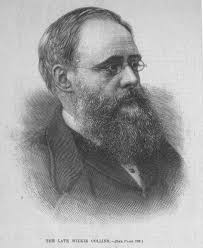
| Wilkie Collins |
I really cannot recommend The Woman in White enough. Marion is one of my favorite narrators in any novel, and she and the other characters greet me like old, eccentric friends whenever I revisit this book. Wilkie Collins' writing style is one that never fails to engage and delight and he succeeds in creating the eerie Gothic mood one might expect from this sort of novel. The novel is from start to finish so suspenseful that I imagine any reader would have difficulty putting it down for more than a few minutes at a time. My only complaint is that it tends to overshadow other classic thrillers that I read. Just as I and many other readers are still searching for the next best fantasy series to Harry Potter, I am still searching for the Victorian thriller that is nearly as good as The Woman in White!
Some favorite quotes:
"The best men are not consistent in good--why should the worst men be consistent in evil?"
"Any woman who is sure of her own wits, is a match, at any time, for a man who is not sure of his own temper."
...and the best of Frederick Fairlie (Laura's hypochondriac uncle):
"I sadly want a reform in the construction of children. Nature's only idea seems to be to make them machines for the production of incessant noise."
"I am a bundle of nerves dressed up to look like a man!"
This book is
suspenseful, extremely well-written, populated with memorable and likable characters
Saturday, June 4, 2016
Saint Joan by George Bernard Shaw
Pages: 160
Published: 1923
I really enjoyed this play, the first I have ever read by George Bernard Shaw. Set in fifteenth century France during the Hundred Years War, it is Bernard Shaw's interpretation of the story of Joan of Arc, revered as both a French heroine and a saint (but only since 1920, nearly 500 years after she was burnt at the stake as a heretic!) I will make a very strange comparison and say that the play reminded me a bit of a particularly brilliant episode of Game of Thrones. It is a series of fascinating, sometimes philosophical and sometimes funny and always confrontational conversations. Bernard Shaw foregoes writing any bloody battle scenes and instead concentrates on developing Joan's character and those of the people who condemned her as a heretic, as well as her supposed allies who essentially stood by and let her be condemned.
I liked that Bernard Shaw portrays Joan as a human being, complete with a very stubborn nature and a propensity for lightly making fun of her supposed social betters to their faces. Honestly, desperate though he might have been, would the dauphin have listened to just any country girl who told him that he could only win back French territory and be crowned if he let her lead his army against the English? No, divinely inspired or not, Joan of Arc must surely have been one tenacious, determined, and even slightly arrogant young woman. She was certainly bold, even reckless enough to suddenly and a bit mysteriously recant her confession at her trial when she had might have been imprisoned for life rather than burned at the stake. Bernard Shaw portrays her as all of these things, as very human.
![]() |
| First printing of Saint Joan |
Joan was burnt not as a witch, as is sometimes thought, but as a heretic. She was tried by a Church tribunal not only for political reasons, but because the Church officials perceived that she felt her direct divine connection to God meant that she must obey Church authority only if it did not go against what her "voices" told her was God's will. Cauchon, the preceding bishop, is actually sympathetic to Joan in the play, not the kind of heartless Catholic monster that a less thoughtful Protestant playwright might have written him as. He tries hard to convince Joan to submit to "the considered wisdom and experience of the Church," but she refuses to believe her spirits could be wrong. So, Joan was maybe a bit of a Protestant. Bernard Shaw actually uses the word "Protestantism" several times in the play, though it is an anachronism, to drive home this point. Though his subject is medieval, the play is very much a product of the 1920s, especially as it reflects on Joan's recent canonization as a saint in 1920.
In the epilogue, a surreal scene in which Joan and those who condemned her reflect on her legacy as ghosts, King Charles VII (formerly the dauphin) says:
"...But I will tell you this about her. If you could bring her back to life, they would burn her again within six months for all their present adoration of her."
In short, Bernard Shaw means that Joan is revered as a martyred saint, but was ridiculed and mistreated during her life. People, whether religious or not, are happy to think of her as a misunderstood "woman ahead of her time," a martyr and a national heroine. But people like Joan--a cross-dressing, sharp-tongued woman who rode into battle and claimed she regularly spoke to Saint Catherine and knew what was best for everyone better than they themselves did--are often better-loved after they are dead, and treated as outcasts or lunatics while they are alive. This was a fascinating perspective on Joan that I had never considered before.
This play is also very funny at times. Bernard Shaw's dialogue reminded me of that of Oscar Wilde, to whom he is sometimes compared, in that he is good at writing aphorisms and witty remarks. Here are a couple of the quotes that I particularly appreciated:
Charles: "If we could only have a treaty, the English are sure to have the worst of it, because they are better at fighting than at thinking."
"Poulengey: "...We want a few mad people now. See where the sane ones have landed us!"
This play is:
poignant, engrossing, surprisingly funny
P.S. I have decided to phase out my old rating system, which basically uses the Goodreads system and substitutes unicorns for stars. One of the benefits of writing reviews is that I can assess books in a more qualitative fashion, and I often cannot even explain to myself why I gave a book four stars instead of five or vice versa. It seems to depend largely on my mood at the moment, so I am going to try using adjectives to sum up my feelings towards and perceptions of books instead.
...This review is part of my Classics Club project!
Wednesday, June 1, 2016
Northanger Abbey by Jane Austen
Genre: classic
Published: 1817
Pages: 250
In her first novel Northanger Abbey, Jane Austen defends fiction in a manner that any ardent reader can not but highly approve of and applaud:
“It is only a novel... or, in short, only some work in which the greatest powers of the mind are displayed, in which the most thorough knowledge of human nature, the happiest delineation of its varieties, the liveliest effusions of wit and humor, are conveyed to the world in the best-chosen language.”
Northanger Abbey is definitely such a novel, though it seems to be sadly underrated compared to other Austen novels. What it may lack a little in page count and dynamic secondary characters, in displaying "the most thorough knowledge of human nature," it more than makes up for in "the liveliest effusions of wit and humor." Here Austen employed her usual candid wit to satirize not only certain elements and stock figures of English high society, but also the lurid Gothic romances like The Monk that were the bestsellers of her day. The result is marvelously entertaining to read and often very funny.
Seventeen year old Catherine Morland is considerate and vivacious, a devoted reader of Gothic romances and a life-long country dweller. When she has the opportunity to travel to Bath with family friends and spend a few months taking tea in gathering rooms and dancing with eligible young men, Catherine jumps at the chance, though she knows little of the manners of high society. However, as Austen's omniscient narrator explains, Catherine's unworldliness can only work to her advantage in the game of attracting a suitor:
"She was heartily ashamed of her ignorance. A misplaced shame. Where people wish to attach, they should always be ignorant. To come with a well-informed mind, is to come with an inability of administering to the vanity of others, which a sensible person would always wish to avoid. A woman especially, if she have the misfortune of knowing any thing, should conceal it as well she can."
One can easily imagine Jane's sardonic smile as she put that last line to parchment.
Catherine initially feels as if she knows no one in Bath, but luckily makes the acquaintance of a certain Mr. Henry Tilney, a clever and charming young man whom she quickly falls in love with. Like any heroine, however, Catherine is beset by countless obstacles. Isabella, another of her new friends in Bath must insist on carrying on in an embarrassing way with Henry's less pleasant elder brother, though she is engaged to marry Catherine's brother! Likewise, Isabella's odious brother John has made up his mind that he is going to marry Catherine, despite the latter's indifference to his pathological lying and scheming. Happily, Catherine is able to escape this intricate and embarrassing situation in Bath after Mr. Tilney and his sister invite her to sojourn at their family home, Northanger Abbey. Catherine is delighted with the abbey and with her hosts...except for General Tilney, Henry's father. As she learns more and more about the sudden death of the late Mrs. Tilney at Northanger Abbey, Catherine begins to suspect that the highly suspicious General poisoned his wife, or else is hiding her away in some secret passage...
Some readers have complained that the love interest Mr. Tilney is no Mr. Darcy or that he is a bit of a 2-D character, but I actually found him to be pretty nearly as well-written as Catherine and just...likable. Fancy that, a love interest being kind and likable instead of going to incredible pains to convince the heroine that he hates her in order to disguise his great passion, or being some "bad boy" that the heroine has to work to redeem! It makes for a nice change. I particularly like his first conversation with Catherine, in which he ironically recollects after talking with her a while that he has forgotten to ask her all the stereotypical small-talk questions about how she likes Bath:
"...forming his features into a set smile, and affectedly softening his voice, he added, with a simpering air, "Have you been long in Bath, madam?"
"About a week, sir," replied Catherine, trying not to laugh.
"Really!" with affected astonishment.
"Why should you be surprised, sir?"
"Why, indeed?" said he, in his natural tone--"but some emotion must appear to be raised by your reply, and surprise is more easily assumed, and not less reasonable than any other."
I also enjoyed the conversations in which Henry playfully parodies Catherine's expectations that Northanger Abbey will be a haunted Gothic monastery filled with relics of the horrible murders which have taken place there, inventing a whole story about her frightening discovery of a secret passageway. However, I guess I cannot quote every passage that I loved here!
Just as Catherine Morland must eventually confess to having been influenced by her insatiable love for reading Gothic romances to judge people before getting to know them, I must confess to having been influenced by my love for Northanger Abbey! After reading it for the first time a few years ago, I determined that I absolutely must read some of these "horrid novels" that Catherine and her friend Isabella thrill over in the book.
I haven't managed to get through the infamous The Mysteries of Udolpho, whose beginning didn't inspire a lot of interest. However, I have read Matthew Lewis's The Monk, Horace Walpole's The Castle of Otranto, Lady Audley's Secret by Mary Elizabeth Braddon, and a number of Gothics by Wilkie Collins, primarily to see if they were as silly as Austen suggests in Northanger Abbey.
My verdict is that yes, Gothic romances can be ridiculous and long-winded, but they are also thrilling and suspenseful and delightfully convoluted, a bit like soap operas. I have no trouble understanding why Catherine and Henry might burn the midnight oils to finish these tales of wronged ghosts seeking revenge, wide-eyed heroines, wicked foreign counts, and unpleasant housekeepers, all set in the most imposing and medieval of architectural structures. Austen's book is a satire of the Gothic thriller, certainly, but as an unabashed fan of the much-maligned genre, I also appreciate her homage to it by way of clever parody. I hope to read more Gothic romances of the sort that Catherine might have encountered soon. As a graduate student studying that period, I can half-convincingly claim them as necessary reading, and I really want to give Ann Radcliffe another chance!
Published: 1817
Pages: 250
In her first novel Northanger Abbey, Jane Austen defends fiction in a manner that any ardent reader can not but highly approve of and applaud:
“It is only a novel... or, in short, only some work in which the greatest powers of the mind are displayed, in which the most thorough knowledge of human nature, the happiest delineation of its varieties, the liveliest effusions of wit and humor, are conveyed to the world in the best-chosen language.”
Northanger Abbey is definitely such a novel, though it seems to be sadly underrated compared to other Austen novels. What it may lack a little in page count and dynamic secondary characters, in displaying "the most thorough knowledge of human nature," it more than makes up for in "the liveliest effusions of wit and humor." Here Austen employed her usual candid wit to satirize not only certain elements and stock figures of English high society, but also the lurid Gothic romances like The Monk that were the bestsellers of her day. The result is marvelously entertaining to read and often very funny.
Seventeen year old Catherine Morland is considerate and vivacious, a devoted reader of Gothic romances and a life-long country dweller. When she has the opportunity to travel to Bath with family friends and spend a few months taking tea in gathering rooms and dancing with eligible young men, Catherine jumps at the chance, though she knows little of the manners of high society. However, as Austen's omniscient narrator explains, Catherine's unworldliness can only work to her advantage in the game of attracting a suitor:
"She was heartily ashamed of her ignorance. A misplaced shame. Where people wish to attach, they should always be ignorant. To come with a well-informed mind, is to come with an inability of administering to the vanity of others, which a sensible person would always wish to avoid. A woman especially, if she have the misfortune of knowing any thing, should conceal it as well she can."
One can easily imagine Jane's sardonic smile as she put that last line to parchment.
| Sketch of a pump room or gathering room in Bath |
Catherine initially feels as if she knows no one in Bath, but luckily makes the acquaintance of a certain Mr. Henry Tilney, a clever and charming young man whom she quickly falls in love with. Like any heroine, however, Catherine is beset by countless obstacles. Isabella, another of her new friends in Bath must insist on carrying on in an embarrassing way with Henry's less pleasant elder brother, though she is engaged to marry Catherine's brother! Likewise, Isabella's odious brother John has made up his mind that he is going to marry Catherine, despite the latter's indifference to his pathological lying and scheming. Happily, Catherine is able to escape this intricate and embarrassing situation in Bath after Mr. Tilney and his sister invite her to sojourn at their family home, Northanger Abbey. Catherine is delighted with the abbey and with her hosts...except for General Tilney, Henry's father. As she learns more and more about the sudden death of the late Mrs. Tilney at Northanger Abbey, Catherine begins to suspect that the highly suspicious General poisoned his wife, or else is hiding her away in some secret passage...
Some readers have complained that the love interest Mr. Tilney is no Mr. Darcy or that he is a bit of a 2-D character, but I actually found him to be pretty nearly as well-written as Catherine and just...likable. Fancy that, a love interest being kind and likable instead of going to incredible pains to convince the heroine that he hates her in order to disguise his great passion, or being some "bad boy" that the heroine has to work to redeem! It makes for a nice change. I particularly like his first conversation with Catherine, in which he ironically recollects after talking with her a while that he has forgotten to ask her all the stereotypical small-talk questions about how she likes Bath:
"...forming his features into a set smile, and affectedly softening his voice, he added, with a simpering air, "Have you been long in Bath, madam?"
![]() |
| Catherine and Henry Tilney in the 2007 Northanger Abbey film |
"About a week, sir," replied Catherine, trying not to laugh.
"Really!" with affected astonishment.
"Why should you be surprised, sir?"
"Why, indeed?" said he, in his natural tone--"but some emotion must appear to be raised by your reply, and surprise is more easily assumed, and not less reasonable than any other."
I also enjoyed the conversations in which Henry playfully parodies Catherine's expectations that Northanger Abbey will be a haunted Gothic monastery filled with relics of the horrible murders which have taken place there, inventing a whole story about her frightening discovery of a secret passageway. However, I guess I cannot quote every passage that I loved here!
Just as Catherine Morland must eventually confess to having been influenced by her insatiable love for reading Gothic romances to judge people before getting to know them, I must confess to having been influenced by my love for Northanger Abbey! After reading it for the first time a few years ago, I determined that I absolutely must read some of these "horrid novels" that Catherine and her friend Isabella thrill over in the book.
![]() |
| Delightful Penguin cover for The Monk |
My verdict is that yes, Gothic romances can be ridiculous and long-winded, but they are also thrilling and suspenseful and delightfully convoluted, a bit like soap operas. I have no trouble understanding why Catherine and Henry might burn the midnight oils to finish these tales of wronged ghosts seeking revenge, wide-eyed heroines, wicked foreign counts, and unpleasant housekeepers, all set in the most imposing and medieval of architectural structures. Austen's book is a satire of the Gothic thriller, certainly, but as an unabashed fan of the much-maligned genre, I also appreciate her homage to it by way of clever parody. I hope to read more Gothic romances of the sort that Catherine might have encountered soon. As a graduate student studying that period, I can half-convincingly claim them as necessary reading, and I really want to give Ann Radcliffe another chance!
Rating:
5/5 stars
This book is one I selected for my Classics Club challenge list. Fortunately, I am off to a pretty good start and have not neglected reviewing the books I read thus far. I am still working on my review for The Awakening--it is turning out to be a difficult book to review!
Tuesday, May 24, 2016
Astrophil and Stella by Sir Philip Sidney
Genre: poetry (sonnets)
Published: 1591
Pages: about 80
Review:
Poor, lovelorn Philip Sidney! He anguished so much about his romantic misfortunes that he absolutely had to pen a sonnet cycle about his beloved, or, more accurately, about the complex and mutable emotions that he felt towards his beloved, Stella. He often decries his own lack of poetic wit with a kind of transparent modesty, and just as often declares, sometimes quite vehemently, his absolute aversion to borrowing from other poets' work:
"And this I swear by blackest brook of hell,
I am no pick-purse of another's wit" (Sonnet 74)
The source of his inspiration? His beloved, of course:
"My lips are sweet, inspired with Stella's kiss."
Be that as it may, with his 108 sonnets and 11 longer songs, Sidney was following in the sonnet-writing tradition of Petrarch, who wrote dozens of Italian sonnets addressed to his beloved "Laura." It has been quite a while since I read those for a class, but I don't recall that Petrarch ever did more than regard Laura from afar (in other words, subtly stalk her). After Laura died young, Petrarch continued to write sonnets about her, complete with imagery of Laura as a heavenly angel, even more worthy of his worship and praise than she had been while alive.
Now, that's romantic!...or maybe that's just creepy? Personally, I feel it's more than a bit creepy, but one cannot deny that both Petrarch and Philip Sidney wrote some beautiful sonnets about their respected beloveds which went on to have a huge influence on literary conventions and the way people write/think about love, desire, beauty, and especially unrequited love.
Reading some of Sidney's sonnets, I could not help but draw a parallel between
"Her eyes, her eyes
Make the stars look like they're not shining" (Bruno Mars, 2010)
and
"When Nature made her chief's work, Stella's eyes,
To color black why wrapped she beams so bright?" (Sonnet 7)
Sidney continues later in that sonnet, still writing of Stella's dark eyes,
"That whereas black seems beauty's contrary,
She even in black doth make all beauties flow"
making me think immediately of Shakespeare's very famous "dark lady" sonnets. Since Sidney's sonnets predated Shakespeare's, might he have been inspired by Sidney just as Sidney was by Petrarch?
I have also read Shakespeare's sonnets, and enjoyed them perhaps more than Astrophil and Stella. Shakespeare (or, at least, Shakespeare's speaker) constructs elaborate puns and playful metaphors, and attempts to bring most of the sonnets to a quasi-resolution in the final quatrain. Sidney, on the other hand, tends to come across as more solemn, melancholy, and tormented, as in sonnet 2:
He writes of how he can scarcely eat, think, converse with women (who he says can only appear as poor "models" of Stella), cannot produce any writing which does not fixate on Stella, feels driven to paint his living hell with his words. He suffers from an eternal wound made by Cupid's arrow (before that was such a huge cliché as it is today!) He pines for the sight of Stella constantly and feels miserable in her absence:
"Since Stella's eyes, wont to give me my day,
Leaving my hemisphere, leave me in night" (sonnet 89)
The hopeless melancholic in me just eats that stuff up! Sidney might not have been as original with his extended metaphors or as clever with his sexual puns as Shakespeare, but he is perhaps more heartfelt. While scholars can never seem to agree on who the "dark lady" and "beloved youth" of Shakespeare's sonnets might have been (or if they were real people at all), Sidney made it pretty transparent that "Stella" was in fact one Penelope Devereux, later called Lady Penelope Rich after her marriage. He puns on her married name, "rich," quite a few times and, unlike Petrarch, Sidney actually had something of a history with Penelope.
When Penelope was a young teenager and Sidney about twenty, their families had began negotiations for the two of them to be betrothed. However, probably as a result of financial circumstances, the betrothal never happened and Penelope instead was forced to marry another nobleman whom she hated. Indeed, she hated him so much that she had an affair with yet another nobleman, an earl, secretly married him, divorced her husband, married the earl "officially," and was banished from court shortly before she died. (Sidney died many years earlier, a "heroic" death in battle which solidified his reputation as the ultimate Renaissance courtier/poet/soldier.) Characteristically, Sidney sulkily blames himself for the marriage negotiations having fallen apart in his thirty-third sonnet:
How much of this was written in earnest and how much of it was Sidney self-consciously trying to introduce Petrarchan sonnets in England, no one can say. But the result was quite extraordinary, that much is certain. I enjoyed reading these sonnets and now intend to read Sidney's Defense of Poesy, which is an essay he wrote defending the merits of fiction against the criticisms of Puritans who called imaginative writing immoral. I also would like to read more sonnets by a later English poet, perhaps Sir Thomas Wyatt, though I have heard his are not as good as Sidney's or Shakespeare's.
Rating:
This book is the first I have read and reviewed for my Classics Club challenge! Next, I will review The Awakening by Kate Chopin.
Published: 1591
Pages: about 80
Review:
Poor, lovelorn Philip Sidney! He anguished so much about his romantic misfortunes that he absolutely had to pen a sonnet cycle about his beloved, or, more accurately, about the complex and mutable emotions that he felt towards his beloved, Stella. He often decries his own lack of poetic wit with a kind of transparent modesty, and just as often declares, sometimes quite vehemently, his absolute aversion to borrowing from other poets' work:
"And this I swear by blackest brook of hell,
I am no pick-purse of another's wit" (Sonnet 74)
The source of his inspiration? His beloved, of course:
"My lips are sweet, inspired with Stella's kiss."
Be that as it may, with his 108 sonnets and 11 longer songs, Sidney was following in the sonnet-writing tradition of Petrarch, who wrote dozens of Italian sonnets addressed to his beloved "Laura." It has been quite a while since I read those for a class, but I don't recall that Petrarch ever did more than regard Laura from afar (in other words, subtly stalk her). After Laura died young, Petrarch continued to write sonnets about her, complete with imagery of Laura as a heavenly angel, even more worthy of his worship and praise than she had been while alive.
![]() |
| Sir Philip Sidney |
Now, that's romantic!...or maybe that's just creepy? Personally, I feel it's more than a bit creepy, but one cannot deny that both Petrarch and Philip Sidney wrote some beautiful sonnets about their respected beloveds which went on to have a huge influence on literary conventions and the way people write/think about love, desire, beauty, and especially unrequited love.
Reading some of Sidney's sonnets, I could not help but draw a parallel between
"Her eyes, her eyes
Make the stars look like they're not shining" (Bruno Mars, 2010)
and
"When Nature made her chief's work, Stella's eyes,
To color black why wrapped she beams so bright?" (Sonnet 7)
Sidney continues later in that sonnet, still writing of Stella's dark eyes,
"That whereas black seems beauty's contrary,
She even in black doth make all beauties flow"
making me think immediately of Shakespeare's very famous "dark lady" sonnets. Since Sidney's sonnets predated Shakespeare's, might he have been inspired by Sidney just as Sidney was by Petrarch?
I have also read Shakespeare's sonnets, and enjoyed them perhaps more than Astrophil and Stella. Shakespeare (or, at least, Shakespeare's speaker) constructs elaborate puns and playful metaphors, and attempts to bring most of the sonnets to a quasi-resolution in the final quatrain. Sidney, on the other hand, tends to come across as more solemn, melancholy, and tormented, as in sonnet 2:
"Not at first sight, nor with a dribbèd shot
Love gave the wound, which while I breathe will bleed,
But known worth did in mine of time proceed,
Till by degrees it had full conquest got.
I saw and liked, I liked by lovèd not,
I loved, but straight did not what Love decreed;
At length t Love's decrees, I forced, agreed,
Yet with repining at so partial lot.
Now even that footstep of lost liberty
Is gone, and now like slave-born Muscovite,
I call it praise to suffer tyranny;
And now employ the remnant of my wit,
To make myself believe that all is well,
While with a feeling skill I paint my hell."
He writes of how he can scarcely eat, think, converse with women (who he says can only appear as poor "models" of Stella), cannot produce any writing which does not fixate on Stella, feels driven to paint his living hell with his words. He suffers from an eternal wound made by Cupid's arrow (before that was such a huge cliché as it is today!) He pines for the sight of Stella constantly and feels miserable in her absence:
"Since Stella's eyes, wont to give me my day,
Leaving my hemisphere, leave me in night" (sonnet 89)
The hopeless melancholic in me just eats that stuff up! Sidney might not have been as original with his extended metaphors or as clever with his sexual puns as Shakespeare, but he is perhaps more heartfelt. While scholars can never seem to agree on who the "dark lady" and "beloved youth" of Shakespeare's sonnets might have been (or if they were real people at all), Sidney made it pretty transparent that "Stella" was in fact one Penelope Devereux, later called Lady Penelope Rich after her marriage. He puns on her married name, "rich," quite a few times and, unlike Petrarch, Sidney actually had something of a history with Penelope.
![]() |
| Penelope Devereux, "Stella" |
When Penelope was a young teenager and Sidney about twenty, their families had began negotiations for the two of them to be betrothed. However, probably as a result of financial circumstances, the betrothal never happened and Penelope instead was forced to marry another nobleman whom she hated. Indeed, she hated him so much that she had an affair with yet another nobleman, an earl, secretly married him, divorced her husband, married the earl "officially," and was banished from court shortly before she died. (Sidney died many years earlier, a "heroic" death in battle which solidified his reputation as the ultimate Renaissance courtier/poet/soldier.) Characteristically, Sidney sulkily blames himself for the marriage negotiations having fallen apart in his thirty-third sonnet:
"I might (unhappy word), O me, I might,
And then would not, or could not, see my bliss:
Till now, wrapped in a most infernal night,
I find how heav'nly day, wretch, I did miss.
Heart, rent thyself, thou dost thyself but right:
No lovely Paris made thy Helen his;
No force; no fraud robbed thee of thy delight;
Nor Fortune of thy fortune author is;
But to myself myself did give the blow..."
He laments,
"How fair a day was near. O punished eyes,
That I had been more foolish, or more wise!"
How much of this was written in earnest and how much of it was Sidney self-consciously trying to introduce Petrarchan sonnets in England, no one can say. But the result was quite extraordinary, that much is certain. I enjoyed reading these sonnets and now intend to read Sidney's Defense of Poesy, which is an essay he wrote defending the merits of fiction against the criticisms of Puritans who called imaginative writing immoral. I also would like to read more sonnets by a later English poet, perhaps Sir Thomas Wyatt, though I have heard his are not as good as Sidney's or Shakespeare's.
Rating:
This book is the first I have read and reviewed for my Classics Club challenge! Next, I will review The Awakening by Kate Chopin.
Saturday, May 21, 2016
North and South by Elizabeth Gaskell
Genre: classic novel
Published:1854
Pages: 450 (paperback)
Synopsis: When her father leaves the Church in a crisis of conscience, Margaret Hale is uprooted from her comfortable home in Hampshire to move with her family to the north of England. Initially repulsed by the ugliness of her new surroundings in the industrial town of Milton, Margaret becomes aware of the poverty and suffering of the local mill-workers and develops a passionate sense of social justice. This is intensified by her tempestuous relationship with the mill-owner and self-made man John Thornton, as their fierce opposition over his treatment of his employees masks a deeper attraction.
Review:
I had this novel in my library for six months before I tried reading it, had to put it aside--due to my having so many other public library and school books to read, my own poor books are often neglected--and eventually started it again a week or so ago. I had heard a lot about Elizabeth Gaskell being the next best thing to Jane Austen, whom I adore, and also knew that she wrote a famous biography of Charlotte Brontë, so I've been eager to read one of her books for a long time.
While I now actually think her writing differs from that of both Austen and Charlotte in several important ways (as much as I can judge from having read just one book, I mean!), I did end up really enjoying North and South and do recommend it to the Austen lover who finds themselves wishing our dear Jane had lived long enough to write many more books. The romance between Margaret and John Thornton is a bit like that between Elizabeth and Mr. Darcy in that they initially seem to take an instant and powerful dislike to each other, but it becomes clear much earlier than in Pride and Prejudice that Mr. Thornton is actually in love with Margaret. Also like Pride and Prejudice, one of the central conflicts that prevents Margaret and Mr. Thornton understanding each other hinges on a misunderstanding.
All of the characters are excellently drawn and, contrary to several other reviewers on Goodreads who complained that she does nothing, I actually thought Margaret was a pretty strong heroine. She is only nineteen years old, but has to weather a lot of family crises and stands up for social justice in a community where she is a complete newcomer in ways that few middle-class English girls at this time would. I found Margaret really likable and admired her strength throughout most of the novel.
I was surprised to find that, unlike most of Austen's novels, North and South features quite a lot of tragedy. It is not a Gothic novel by any means, but Margaret encounters sorrow after sorrow after her father--ugh, his character got on my nerves at times, he is so weak!-- decides that he can no longer be an Anglican priest in good conscience and uproots his family to the northern town of Milton, a fictional place which is essentially modeled after the very industrial town of Manchester. I was surprised and interested to read the religious debates and Dissenting (Nonconformist) elements that arose in this novel, because religious doubts and questioning has not really been a major theme or even a plot point in other Victorian novels I have read.
There is also a strong theme of social justice and questions about whether employers are inherently exploitative of their employees in this mill town where many working-class people suffer from overwork, being underpaid, and of course industrial diseases like the ones then called brown lung and black lung. Mr. Thornton is a firm capitalist, and has risen through hard work from being a shop boy to a mill owner. Margaret, a priest's daughter from the south of England (whose economy relied more on agriculture than industrial factories), disapproves of his coldness towards his working-class employees at the mill, some of whom she befriends. Her new friends, a tubercular girl called Bessy and her father Nicholas, speak in this local dialect that is annoying to read, but it is worth it because they are characters who add a lot to the novel. There is a strike at Mr. Thornton's mill which turns really violent--mobs and windows being broken!--and Margaret gets swept up in this class conflict despite being an outsider and having more than enough of her own troubles to deal with in her own family. Without giving anything away, Gaskell seems to be proposing, at the very least, that employers and workers should negotiate on equal ground so that the needs of both economic productivity and the people who tend to benefit least from it (the workers) can be served.
I look forward to reading more of Elizabeth Gaskell's novels, not least a Penguin collection of her Gothic Tales which I really want to read! She writes beautifully, and with more attention to themes of social justice and the lives of working-class people than Austen or the Brontë sisters, who tend to write about comfortably middle-class or gentry people. I highly recommend this book to those who are interested in learning more about the lives of people in Victorian England more broadly and, of course, to anyone who likes romances set in this period. It is really an excellent novel, and well-deserving of its status as a classic!
Rating:
Wednesday, May 18, 2016
Classics Club Challenge List
As a voracious reader of classic novels, essays, plays, poetry, etc, I thought it was high time I officially joined the Classics Club! The Club connects book bloggers who are also avid readers of the classics and provides a place for readers to share and discuss their reading. Each member selects at least 50 classic titles and takes on a challenge to read all of the books by a certain date. I have just started to check out the club and its members' blogs, but am finding it all to be really excellent, and I did miss reading challenges during my lost hiatus from blogging.
Actually one of the reasons I stopped blogging for such a long while is that I felt less interested in reviewing the new releases that are a big part of the book blogosphere culture because I realized (as I started a dual English/History degree) that I really wanted to start reading much older books, the classics that have shaped other books since and our world as a whole. Hopefully this challenge will help me keep up my classics-reading momentum.
I hope to complete my list of 55 books by May 18th, 2017, exactly one year from now (May 18th, 2016.) In addition to literature, I have included a few historical surveys which are considered true classics in their fields. I will try to review each book as I finish it and link to the review here. Without further much ado about nothing (which, btw, is a great play!), here is my alphabetical list of the 55 books I am going to read:
--Agamemnon by Aeschylus
--Eumenides by Aeschylus
--The Libation Bearers by Aeschylus
--Lysistrata by Aristophanes
--Selected Poems by Aphra Behn
--The Decameron by Giovanni Boccaccio
--Something Wicked This Way Comes by Ray Bradbury
--Agnes Grey by Anne Brontë
--The Professor by Charlotte Brontë
--Shirley by Charlotte Brontë
--Villette by Charlotte Brontë
--The Anatomy of Melancholy by Robert Burton
--The Canterbury Tales by Geoffrey Chaucer
--The Awakening by Kate Chopin (review in progress)
--Murder on the Orient Express by Agatha Christie
--The Idea of History by R.G. Collingwood (history)
--The Origin of Species by Charles Darwin
--The Heptameron by Marguerite de Navarre
--Confessions of an Engish Opium Eater by Thomas de Quincey
--Hard Times by Charles Dickens
--La Reine Margot by Alexandre Dumas
--Middlemarch by George Eliot
--A Passage to India by E.M. Forster
--A Room with a View by E.M. Forster
--Sophie's World by Jostein Gaarder
--Cranford by Elizabeth Gaskell
--Gothic Tales by Elizabeth Gaskell
--The Life of Charlotte Brontë by Elizabeth Gaskell
--Mary Barton by Elizabeth Gaskell
--Selected Poems by Thomas Hardy
--Collected Ghost Stories by M.R. James
--Selected Essays by Rosa Luxemburg
--Paradise Lost by John Milton (re-read)
--Selected Essaies by Montaigne (French)
--1984 by George Orwell
--Animal Farm by George Orwell
--The Bell Jar by Sylvia Plath
--Phèdre by Jean Racine (French)
--The Mysteries of Udolpho by Ann Radcliffe (review in progress)
--Selected Poems by Rainer Maria Rilke
--Coriolanus by William Shakespeare
--Cymbeline by William Shakespeare
--Mrs. Warren's Profession by George Bernard Shaw
--Saint Joan by George Bernard Shaw
--The Life and Opinions of Tristram Shandy, Gentleman by Laurence Sterne
--Gulliver's Travels by Jonathan Swift
--The Annals by Tacitus
--Selected Poems by Lord Tennyson
--The Making of the English Working Class by E.P. Thompson (history)
--Walden by Henry David Thoreau
--Selected Poems by Paul Verlaine (French)
--The Voyage Out by Virginia Woolf
--Selected Poems by William Wordsworth
Thursday, May 9, 2013
The Turn of the Screw by Henry James
Pages: 172 (paperback)
Published: 1898
Synopsis:
Henry James, a master of haunting atmosphere and riveting tension, presents one of the most famous ghost stories of all time. A young governess is sent to a country home to take charge of two orphans, and unsettled by a sense of intense evil within the house, becomes obsessed with the belief that malevolent forces are stalking the children in her care. Growing increasingly uneasy, she becomes drawn into a frightening battle against an unspeakable evil that may or may not be real.
Review:
I was almost entirely unfamiliar with this admittedly well-known classic ghost story before reading The Turn of the Screw. I've seen the Nicole Kidman movie it inspired, The Others, but otherwise came into this not knowing what to expect. The Woman in Black (which I someday might review) is one of my favorite short horror novels. It isn't Victorian, but it is set in that time period and shares some of the same eerie psychological horror with Turn of the Screw-- but this little book turned out to be far better.
So, the story is a story within a story-- a guy at a party tells a story about a ghost story which he has written down by a woman he once knew to someone, presumably Henry James. So, metafiction-- and for the rest of the book this doesn't come up again. The protagonist and first-person narrator after the prologue is a young governess, the daughter of a parish priest. She goes to the country estate of Bly (and how might one pronounce this??) to take care of two children at the behest of their always-absent-on-business uncle. We never learn this governess's name or much about her, already evoking a sense of mystery and, well, vagueness.
The two children, Flora and Miles, who the governess must look after fit the Victorian ideal of children: they are angelic in both appearance and behavior, bright and determined to please. Our narrator is happy in her new position-- until she begins to see a strange man, a man who she instinctively feels to be evil, around the grounds of Bly.
I don't think it is much of a spoiler to add that there are two main readings of The Turn of the Screw, as you might guess from just reading the synopsis: A. this is a true ghost story, and the governess, having perfectly identified the ghosts of people she had never met, is correct in that these spectors are trying to lead the children to their own deaths (and possibly corrupt them as well). Reading B: the governess is paranoid, to the point of halluncinating the apparitions, and possibly insane; she creates malevolent figures where in fact there are none, for various psychological reasons. I lean towards reading B, though I don't have a satisfying explanation for how the governess knew what Quint and Miss Jessel, the other ghost, looked like. The character of Mrs. Grose-- the housekeeper-- seems suspect in this: maybe she matched the governess's vague descriptions of the apparitions to those of Quint and Jessel because she had always thought them to have sinister intentions. The thing is, there are several occasions when the governess sees the ghosts and points them out hysterically to the children or to Mrs. Grose, and nobody else sees anything. Maybe a "meeting point" between the two readings is that Jessel and Quint did corrupt the two children-- the boy and the girl-- before their deaths, and their dark influence lingers, though they are not ghosts, in the sometimes bizarre behavior of the children. Miles in particular turns out to be much less angelic than he first appears to be...
The governess's conviction towards the nature of the ghosts has the reverse effect of causing the reader to be skeptical of their existence. Anyway, so I really enjoyed this book. And yet, halluncinations or not, these ghosts are more frightening to me than the ones which populate 21st century horror movies. The description of the "pale face" of the ghost of Quint looking in through the window at the children having dinner is beyond eerie-- oh, that scene beat out only by the one with Miss Jessel by the governess's writing desk! And I feel like I'm spewing spoilers again, but point being, there are some truly eerie scenes.
The Turn of the Screw succeeds as a ghost story and as an interesting character study...the ambiguity of the supernatural elements and the governess's identity is great and, actually, a little bit maddening. The ending came as a shock to me, to say the least. Not sure how I missed the million BBC adaptations of this, but I'm glad I did-- this thin pageturner packed with heavy ambiguity and a great deal of creepiness was a unique reading experience.
My rating:
Sunday, February 10, 2013
Classically Readable #3: Treasure Island
Genre: classics/ historical adventure
Pages: around 250 pages, depending on the edition
Published: first published 1883
Review:
I can't honestly say that Treasure Island wasn't exactly what I expected it to be, but that's by no means a bad thing. It is the classic adventure story, beloved by children and adults for over a century. This is the book which more or less gave birth to the modern image of the swashbuckling, peg-legged/one-eyed pirate-- plot-wise, I saw some major fodder for modern pirate films like Cutthroat Island and Pirates of the Caribbean. All in all, Treasure Island is far from a timeless thought-provoker, but it is a classic worth reading all the same.
Our protagonist Jim Hawkins is a young innkeeper's son who is half-fascinated and half-terrified by the little English inn's long-time resident, an intimidating, seafaring drunk who prefers to be known only as "The Captain". Following the Captain's exciting demise and the arrival of a band of loathsome pirates (with various physical disfigurements), Jim chances to find a treasure map hidden away in the dead Captain's chest. Having recruited the game Dr. Livesey and some of his noble friends to sail to this mysterious treasure island, Jim joins the schooner crew as a cabin boy. Enter Long John Silver, one of the most infamous and ambiguous of all literary villains. Silver, a ship's cook who charms both Livesey and Jim, gets together a crew of his sailing buddies to join in on the treasure-hunting adventure. The fabled island is discovered amidst a mutiny at sea and there is a battle for the treasure booty between Jim and Livesey's party and Silver's mutineering ex-pirates.
There are two interesting characters in Treasure Island: Jim Hawkins, our narrator, and Long John Silver. Jim struggles to decide what and who to believe, as the seemingly charming and honest John Silver reassures him time and time again that sticking with Silver is his best chance at surviving the deadly conflicts between the two parties which rage over sea and land. He's a clever, likeable protagonist from humble beginnings, and he's a really great narrator. (Stevenson's writing style is not what you would call old-fashioned, either-- this book is one of the easiest 19th century novels I've ever read). Silver definitely has the reputation of being one of fiction's greatest villains, but I also think he must be one of the most interesting. After years at sea, during which he lost a leg and served as a quartermaster and ship's cook, John Silver has the strange twin reputation of being both a friendly, helpful man and a cunning, brutal one, depending on who one asks. His seemingly morally ambiguous character and his unexpected fate at the novel's end both totally defy villain conventions which are still standard today, and were even more standard in the 1800s when Stevenson wrote Treasure Island.
Treasure Island was not originally published as a novel, surprisingly enough, but as a serial in a children's magazine titled The Mutiny of the Hispaniola. On one level, the book can be considered a pretty typical, if especially exciting, adventure story of the era in the tradition of the ever-popular Robinson Crusoe. Having read it, I think that it must be Stevenson's fantastic prose which has made the novel so immortal in children's literature and literature as a whole, along with the characters of John Silver and Jim. The story itself has as many twists and scallywag characters as your typical Pirates of the Caribbean movie, except that Treasure Island's story actually makes sense and, you know, there aren't any skeletal pirates or vicious, man-eating mermaids hanging around. In the end, this book is by no means a mind-blowing read, but it is fun, influential, and fast-paced classic which is still deserving of its classic status.
Book Rating:
Thursday, January 10, 2013
Classically Readable #2: Sense & Sensibility by Jane Austen
Genre: historical romance
Pages: 400, give or take depending on the edition
Published: 1811
Synopsis:
Marianne Dashwood wears her heart on her sleeve, and when she falls in love with the dashing, but unsuitable John Willoughby, she ignores her sister Elinor's warning that her impulsive behaviour leaves her open to gossip and innuendo. Meanwhile Elinor, always sensitive to social convention, is struggling to conceal her own romantic disappointment, even from those closest to her. Through their parallel experience of love - and its threatened loss - the sisters learn that sense must mix with sensibility if they are to find personal happiness in a society where status and money govern the rules of love.
Review:
I think that I'd almost like to have been a gentry lady in Ms Austen's time. Her characters-- in Sense and Sensibility, the sisters Dashwood and their many privileged friends-- seem to spend the vast majority of their time either playing piano and chatting about the cutest boyfriends or "beauxs" in sitting rooms, visiting other country mansions, or whiling away the day reading. Of course, the downside is that women's fortune and lifestyles depended completely on whoever they married, and wealth was everything.
What I loved so much about Pride and Prejudice is how brilliantly it depicts the romance and society of the era-- Austen is a very frank writer, especially for her time, I think, and sometimes downright hilarious. Sense and Sensibility was her first novel, but I really could hardly tell and liked it almost as much as P & P (which I recently watched the movie version of, the one with Keira Knightley-- it was awesome). Her style of writing is sometimes hard to decipher, but once you get 50 pages into the book, you become entirely used to the long sentences and abundance of commas and early nineteenth century prose. Her masterful prose is one of the things which make her books so special and popular in the modern day.
But: Sense and Sensibility. The three Dashwood sisters live a modest (for rich English gentry) life after the death of their father and know that their well-being depends on their being able to marry well, to someone wealthy and suitable. The eldest sister Elinor is about as sensible a young lady as you would ever meet; she's very hesitant to express great emotions and uses logic in every decision she makes. Meanwhile her sister Marianne is much less sensible (...and you see where the titles comes in. Actually, Marianne's downright excitable, vivacious and overly dramatic. While walking near a country estate, Marianne chances to fall and twist her ankle, only to be rescued by a young man who happens to be hunting right by where she has her accident and who graciously carries her safely home. Marianne proceeds to lie in bed with her ankle for several days (when people where I live sprain an ankle, they usually just keep on limping) and, upon recovering, spends all her time with her rescuer, the equally excitable and passionate Willoughby. Willoughby and Marianne seem to be a perfect match, but Marianne's suitor has little money or prospects, and the always logical Elinor doubts his suitability.
Elinor, meanwhile, also has a suitor: a young man called Edward, who comes from a wealthy family and wants to join the clergy. Edward, to me, was the least interesting of the gentlemen characters in S & S. In Austen language, he "seemed to me to be rather droll". Willoughby is like the Austen version of a literary bad boy, so he and Marianne's romance, and the knives which get thrown in it, is much more interesting than what goes on between Elinor and Edward. It's not that I didn't like Elinor; more that I really didn't care anything about Edward. We get no sense of his personality, except that he's much more restrained and reluctant to go against the wishes of his domineering mother. Elinor has a romantic rival for Edward's heart in the form of Miss Lucy Steele, a slightly less well-off and "well-bred" girl who it's difficult to decide whether to love or hate. All of the characters, with the exception of Edward, are fantastically interesting and for the most part likeable. The outspoken and gossipy Miss Jennings takes the Dashwood girls under her matronly wing and lets them stay with her for a season at the social capital of London-- she was one of my favorite characters, and added to the comedy and confusions of the novel. I sorta felt sorry for the third Dashwood sister, Margaret. Just like the fourth sister in P & P (now what was her name again?), she has no adventures or romantic prospects whatsoever. Maybe someone should write some fanfiction in which Margaret becomes the first woman Chancellor of England, travels to Narnia, or at least gets married or something.
Tangent aside, the only question which remains is which Jane novel I should read next. I kind of like the title Northanger Abbey, but Emma also sounds interesting. You shouldn't need my advice to read this well-loved and always acclaimed book, but I'll say it anyway: read Sense & Sensibility, because its funny and clever and beautifully written and memorable. And just generally awesome.
Rating:
Thursday, January 3, 2013
Classically Readable #1: Alice's Adventures in Wonderland
Now, without further ado: Alice. So picked because it's a fun classic to start with, short and easy to read. I read and re-read an Alice picture book when I was younger, saw the Disney movie along with a million other kids, love the quirky 2010 Tim Burton movie, and have a poster of the Cheshire Cat up in my room. But I was always curious to read the original stuff-- the literary madness which started it all...
Genre: children's fantasy
Pages: varies a lot depending on the edition-- usually more than 100, but less than 150 pages
Published: 1865 by Lewis Carroll (a pseudonym for Charles Lutwidge)
Selected Theme Song:
Review:
Seven-and-a-half year old Alice is sitting outside with her sister one lazy afternoon when she chances to see an unpunctual, talking rabbit with a pocket watch run past. Adventuresome Alice is quick to pursue and so tumbles a long way down a rabbit hole. At the bottom she finds an enchanted, unfamiliar, and incredibly random world. In Wonderland, the Mad Hatter and March Hare have an endless tea party with their dozy friend the Dormouse and the fearsome Queen of Hearts holds court among her playing card subjects. Also present (and less well-represented in the movie versions) is a wailing baby who sometimes turns into a pig, a very rude Duchess, an unfortunate lizard, and a very unfair criminal trial preceded over by the King and Queen of Hearts. Young and very British Alice causes quite a stir in this bizarre world, for her 'perfectly sensible' ways of doing things seem as alien to the inhabitants of Wonderland as they are to her. Alice quickly finds that, in the kingdom at the bottom of the rabbit hole, one must struggle to keep one's proper size, talking mice can be surprisingly touchy on the subject of cats, and keeping one's head on one's shoulders is a much greater challenge than she would have hoped.
Alice is a perfectly mesmerizing tale: completely unpredictable and engrossing, not least due to the fact that it seems to be complete nonsense, interspersed with parody poems and filled with purposeful paradoxes. This nonsensical quality is what has kept it a classic over the century and a half since it was first penned and inspired so many film adaptations and art. As I read it, I wondered: was there a method to the madness of Alice? Author Lewis Carroll-- actually Charles Lutwidge, an English writer and deacon-- is usually considered to have loosely based his heroine Alice on a real-life girl called Alice Liddell. Carroll invented the story to entertain Alice and her two sisters during an afternoon rowing and later wrote the story down, with some additions. Alice became a children's classic almost immediately after it was published, though in the modern day it seems like adults read it more often than children (?-- most of the children I know read If You Give A Mouse A Cookie more than Alice) The sequel, Alice Through The Looking Glass, was published afterwards but tends to be lumped in with the events of the original Alice (for example, the walrus and the carpenter poem actually appears only in Looking Glass).
More analytical, sinister, and maybe unlikely interpretations of Alice are everywhere-- many people like to believe that Carroll's characters represent real-life figures, or that his stories are symbolic, with important themes or political commentary. There are also some long-running rumors still going around about how Carroll was an opium addict or liked little girls a little more than he should have (ugh), but I really don't know how much credibility those have. I "get" some of these allegorical claims for Alice: like the Queen of Hearts is supposed to be a caricature of Queen Elizabeth I, who the author didn't much like and the crazy Wonderland system of justice a parody of the British court system. Another theory I found is that Alice's sometimes scary, sometimes whimsical adventures represent her coming-of-age in an era when-- just like today, I guess-- growing up had extreme ups and downs.
Most people in the know do agree that Carroll wrote the books (Adventures and the later Looking Glass) with his friend Alice Liddell in mind, and as a dedication to her even after she grew up and moved away, which she did shortly after he published his book. Thinking of Alice in this way puts a melancholy spin on the story, but Alice as a book couldn't be more light-hearted and even funny in its weird, whimsical way. I was totally thrilled to discover that the original Alice is definitely worthy of having inspired so many other stories, art, and films. I adored this classic children's book, but the jury is still out on whether all children enjoy Alice's nonsensical adventures, or if some would find them simply confusing.
Rating:
Subscribe to:
Posts (Atom)